Two numbers show up on most storage quotes. Power. Capacity. Then a signature line, and good luck. Nobody hands over the key to the cabinet with the contract, and the cabinet is where the entire argument hides. Same headline, 100kW/215kWh versus 100kW/241kWh, same port, same shipping agent invoicing in triplicate, and after two summers these twins behave like strangers who refuse dinner together. What’s different? What’s inside. How the cells get welded and supervised. How current crosses DC to AC, and what each crossing bills. Which software picks the charging hour while the factory sleeps. How heat gets out of a sealed box, and who notices at 2 a.m. when one module drifts in a yard where nobody is awake. Read a quotation against the seven subsystems below and a foggy comparison sharpens into a written question list, which suppliers squirm at far more than brochures.
Three acronyms cause most trade-show confusion, so vocabulary first, sorry. The cabinet hoards direct current (DC) in lithium iron phosphate cells and trades alternating current (AC) with the factory and whatever the grid is doing that week. The box doing that trading, battery side, is the PCS (power conversion system), flowing both ways, unlike a PV grid-tie inverter, that one-way street pushing only outward. The EMS (energy management system) decides when to hoard and when to sell, watching tariffs and load. Everything else welded to the sheet metal shields those three. Or bills you for its absence later, pick one.
Three Systems That Set the Earnings
Cells, the Way They’re Actually Sold
Nobody orders lithium in a drum. The conference slides pretend otherwise, reality disagrees. Cells get welded, series and parallel, into modules, modules get harnessed into packs, packs get stacked into the cabinet, and every rung of that ladder bolts in more fixing, more insulation, more data wiring for a human to terminate at forty degrees in the shade (there’s no shade; ask the electrician). Grade A cell poetry amounts to nothing without the BMS (battery management system) riding inside the pack, since that little board watches voltage, current and temperature at cell level, evens the gaps, and refuses anything outside a safe window. Four ordinary ways kill a lithium pack young. Overcharge. Deep discharge. Heat. Imbalance. All four land on the BMS desk before the failure report. Comparing cabinets therefore means asking real questions. Pack count? Module layout? What gets logged, and how far back? A cheap BMS writes logs nobody can read. Year three is when somebody finally tries.
The PCS, or the Quiet Tax on Every Cycle
DC in, AC out, and the PCS stands at the gate taking a cut each crossing, in conversion loss, charged against every cycle the project runs, forever, audited or not. Voltage window, memorize it, it’s the fastest way to catch a vendor cross-shopping solar gear into storage duty. A PV string inverter needs a wide DC window, panel voltage wandering all day with heat and light. A storage PCS works a narrow band that the chemistry itself draws with its charge and cutoff floors, no negotiating. 3.2V per iron phosphate cell, 3.6V at top, 2.5V at floor, several hundred in series, arithmetic nails the range shut. Not marketing. Arithmetic. Any vendor claiming a PV inverter doubles as storage gear deserves that question in email, datasheet attached, not whispered at a booth next to the shrimp. One more thing lives in this box. Grid support. Storage bends to frequency commands the way solar never can, provided somebody wrote that firmware, not just the brochure line.
The EMS, the Difference Between a Battery and a Paycheck
Hardware decides whether a cabinet runs. The EMS decides whether it pays, which is the sentence nobody prints on the quote. Fine. Load lurches by the minute, solar chases weather, tariff windows slide with seasons, and the right move hangs on all three plus what the cells still hold. A serious EMS holds prices, load and battery state in one head at once. Buys in the cheap window. Spends into the expensive one. Clips the demand spike before the meter writes it down. Keeps midday solar at home rather than exporting it for coppers, which nobody admits out loud, weekly though. Same brain handles safety, talking to BMS, PCS, cooling and fire systems, trimming setpoints as readings wander, stopping the machine when stopping beats explaining. Two questions strip any EMS claim to the studs, dealers hate them. Which tariff strategies does delivered software actually support? Next year’s tariff change, settings page or fresh purchase order? Honest answers diverge wildly, which is exactly why both belong in writing.
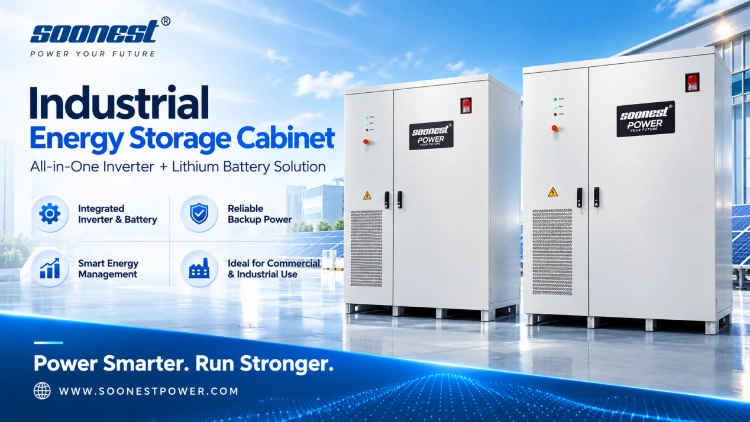
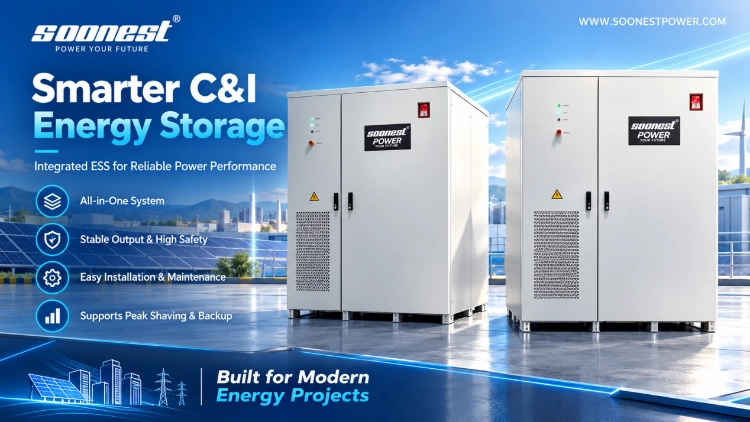
One manufacturer assembles most of these subsystems under its own roof, incidentally. Zhejiang SOONEST New Energy, 20 years of PV equipment, cabinets built beside its inverters and lithium packs, CE, ROHS, SONCAP, UL and ISO paperwork aimed at Africa and the Middle East, short blame chain. The product index spreads the family. The three-phase hybrid inverters for 380V sites pick up the AC side once projects get fat.
Four Systems That Decide Whether the Cabinet Exists in Year Five
Storage people repeat one ugly saying, and ugly sayings here are statistics wearing a costume. Roughly a third of field failures trace to the battery. The rest? Distribution and protection, nearly all of it. Contactors, busbars, surge arresters, breakers, signal wiring, boring traffic carrying every amp the cabinet moves, both directions, thousands of times, without applause. Cheap contactors chatter. Skinny busbars run warm. Omit one surge arrester and a single lightning season retires a control board nobody insured, discovered months later on a site visit. Ask an inspector what predicts a bad cabinet, the datasheet or the wiring layout, label quality, whether a wrench can reach a bolt. He’ll answer with his phone open, gallery side up.
Heat plays the patient game. Cells age quickest outside their comfort band, so a warm cabinet, one whose top shelf runs several degrees over the bottom, surrenders capacity years ahead of a cooler twin, which explains one cell brand showing five years in one depot and eight in another. Big cabinets go liquid, coolant sloshing, pumps humming, built for deep daily cycling; the honest failure mode is a pump dying at 2 a.m. while the cabinet performs innocence. Air cooling costs less, suits a small box living gently, and wheezes under real duty until its owner studies thermodynamics through an invoice. Fire protection reasons identically. Detectors plus clean-agent suppression, sized for a sealed enclosure, exist so one failing cell stays one failing cell, since suppression arriving after the fire is a very expensive kettle. Around all of it stands the cabinet itself, structure, waterproofing, corrosion allowance, safe clearances, in a yard where sun, dust and rain never take leave.
Four more questions belong in the same email as the earnings four, one thread, so nobody cherry-picks the gentle ones.
| Ask this | Because this is what it protects |
| Cooling type and control setpoints | How much capacity survives to year five |
| Suppression agent and detector types | Whether an early cell fault stays early |
| Breaker and contactor brands | Whether distribution survives thousands of cycles |
| Warranty split, cells versus electronics | Which replacement bill arrives second |
A Pre-Purchase Walk-Through That Costs Nothing
Send what follows to two suppliers, three at most, and read the answers for their shape, not their numbers. The cheap build leaks out of its own prose long before the price column opens. Modern designs scale capacity, battery rooms get drawn for replication, electrical bays leave room for switchgear, parallel cabinets count as planning, not favors.
| Check item | On the earnings side | On the survival side |
| Ask in writing | Pack count, module layout, BMS log depth | Cooling type, setpoints, suppression agent |
| Measure against duty | PCS two-way efficiency at half load | Breaker and contactor brands on the bill of materials |
| Confirm terms | EMS tariff options and update costs | Warranty split between cells and the rest |
| Plan ahead | Parallel expansion rating of the switchgear | On-grid/off-grid switching time, in milliseconds |
Tariffs spread, loads shift, weather moves, and the cabinet tuned for one factory frequently fits nobody else down the road. The site at soonestpower.com sets the cabinet line beside its inverters, and the comparison turns specific once a load curve and a tariff sheet reach a human through the contact page.
FAQ (häufig gestellte Fragen)
Does a Storage Cabinet Need a Separate PV Inverter to Charge From Solar?
Not always, and always does suspicious work inside that question. Plenty of cabinets keep room, AC or DC side, for PV to land directly, hybrids pair storage conversion with solar natively. Real variables: matching voltage windows, and whether surplus stores before an export cap bites. That answer belongs on a datasheet read by somebody with no commission riding on it.
What Should a Buyer Check First When Two Cabinets Quote the Same Price?
Cooling and protection hardware, before the cells lull anyone into comfort. Cells commoditized enough that matching quotes mean matching cells, so the cheaper build hides elsewhere. Liquid versus air cooling. Breaker brands nobody recognizes. Suppression sizing. BMS depth. Each hiding place carries either a repair invoice or a capacity curve sagging early, rarely both, always one.
Can One Factory Cabinet Expand Later?
Usually, when planned rather than improvised around. Modular cabinets take parallel units happily, but hard limits sit in switchgear rating plus the local grid agreement. Which is why the expansion question is cheapest while it sounds hypothetical, during the first purchase, when swapping a breaker costs nothing and nobody has poured concrete anywhere.