
When a hot afternoon pushes every room past comfort level, an AC/DC Hybrid Solar Air Conditioner can do more than cool the air. It can change where your cooling power comes from.
SOONEST is a new energy manufacturer with about 20 years in photovoltaic products, inverters, lithium storage systems, and solar air conditioning. Its product range is built for homes, commercial spaces, off-grid projects, and overseas buyers that need practical solar power products, not just catalog promises. The company also supports OEM, ODM, and customized services, with products exported to Asia, Africa, Europe, the Middle East, and the Americas.
Europe’s recent heatwaves show why this topic matters. Xinhua reported that Germany reached 41.7°C on June 28, London subway temperatures neared 40°C, France planned emergency purchases of 30,000 air conditioners for hospitals, and only about 20% of European homes have cooling equipment. China-made cooling products also saw strong demand across Europe, with China’s air-conditioner exports to Europe up 72.8% year-on-year in June.
Why Are Summer Cooling Bills Becoming Harder to Control?
More Heatwaves in Real Homes
Cooling is no longer just a comfort upgrade. In many regions, it is becoming basic summer infrastructure. Schools, hospitals, apartments, guest rooms, and small offices all feel the same pressure: people need cooling exactly when the grid is under stress.
That is where the cost problem starts. A normal grid-powered air conditioner may work well, but it pulls electricity during the most expensive and crowded hours. In some buildings, the bill does not rise slowly. It jumps. A few weeks of heat can change the whole monthly budget.
Low Cooling Readiness in Older Buildings
Many older homes and public buildings were not designed for air conditioning. You may have limited wall space, weak wiring, or no clear outdoor-unit position. Some users buy portable units first, then discover they are noisy or costly to run. Not a great summer memory, honestly.
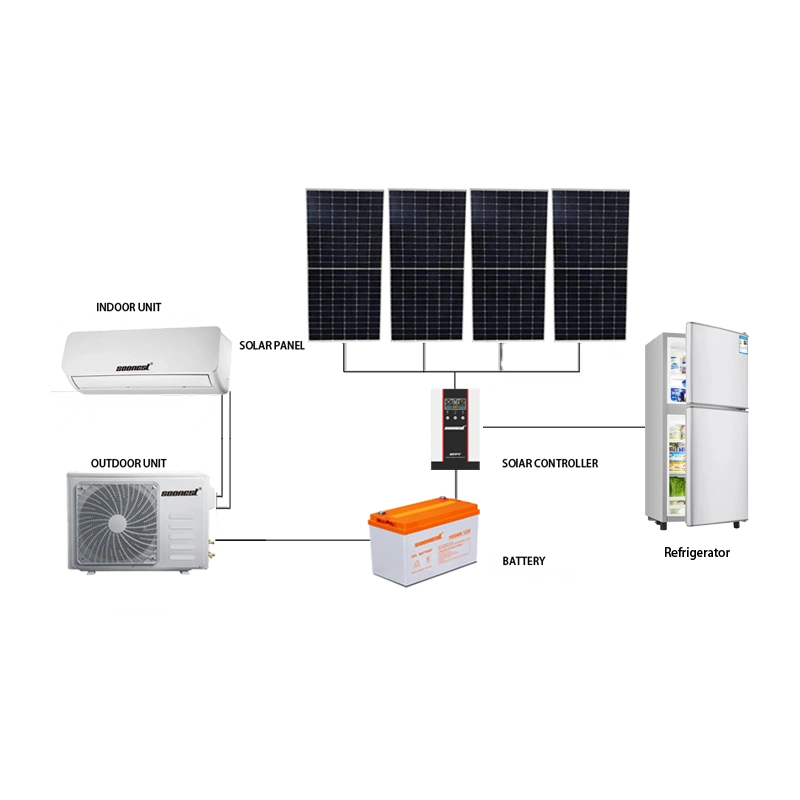
A hybrid solar unit is not a magic fix for every building. But it gives you a more flexible route because the power system is part of the product idea. The 48V to 110V/220V hybrid grid solar air conditioner is made to work with solar panels and grid power, rather than treating solar as an afterthought.
Peak-Time Power Pressure
The hottest time of day often matches the strongest sunlight. That sounds obvious, but it is important. If your cooling load is highest when solar panels can produce useful power, then solar cooling becomes a direct match.
| Cooling Market Fact | Reported Data | Why It Matters |
|---|---|---|
| Germany heat record in late June | 41.7°C | Shows extreme cooling demand in temperate markets |
| European homes with cooling equipment | About 20% | Large gap between demand and installed capacity |
| China AC exports to Europe in June | +72.8% year-on-year | Confirms fast market response to heat stress |
| French hospital emergency AC plan | 30,000 units | Cooling is moving into public health planning |
How Does Solar Power Fit Daily Cooling Demand?
Daytime Solar Output
Solar panels produce direct current power from sunlight. Industry knowledge also confirms that photovoltaic modules are the core part of a solar power system because they convert sunlight into DC electricity. For air conditioning, this timing is useful. People usually need more cooling after noon, not at midnight.
An AC/DC Hybrid Solar Air Conditioner can use solar energy during sunshine hours, so part of your daytime cooling demand may move away from the grid. This does not mean every site gets the same saving. Roof space, shading, local sunlight, room size, and usage habits all matter. A south-facing roof in Spain is not the same as a shaded apartment in northern Europe.
Direct DC Power Use
The hybrid unit is powered by both DC and AC electricity. Its product page states that it uses solar panels to generate DC power and can switch between DC and AC power sources as needed. It also lists automatic switching between DC solar energy and 110VAC/220VAC grid power.
That matters because every energy conversion can bring losses. The product page also notes that the system can eliminate inverter losses in 100% DC systems. For buyers comparing solar cooling options, this is a useful detail. You are not just adding a solar panel to a regular air conditioner. You are choosing a cooling system designed around solar input from the beginning.
Grid Backup Without Daily Guesswork
Solar power is strong at noon, weaker in the evening, and unpredictable during storms. So a cooling system should not depend on sunlight alone unless the project is carefully designed. This model supports 110V/220V grid power, so you can keep cooling when sunlight drops.
That is the practical reason hybrid design matters. It gives you solar-first use when conditions are good, then grid support when needed. In regions where oil and gas price swings still affect power costs, reducing daytime grid use can also make energy planning less nervous. Not exciting wording, but very real for facility managers.
What Makes the AC/DC Hybrid Solar Air Conditioner Different?
AC/DC Hybrid Solar Air Conditioner for Peak Loads
The biggest difference is the power structure. A traditional air conditioner asks one question: is there grid power? This system asks a better question: can solar cover part of the load first?
The product page says the unit can be 100% driven by solar energy during sunshine time, with maximum energy saving listed as 100%. It also states that the system can cut energy bills by 30% to 100%, depending on solar use. In real writing for buyers, it is better to explain this carefully: savings depend on sunlight, panel size, installation quality, operating hours, and how often the grid must step in.
| Product Feature | Listed Data | Buyer Benefit |
|---|---|---|
| Solar input | 48V DC | Fits low-voltage solar cooling designs |
| Grid input | 110VAC/220VAC | Works in many overseas markets |
| Power switching | DC solar / AC grid | Keeps cooling more stable |
| Operating temperature | -10°C to +55°C | Suitable for hot regions and mixed climates |
| Energy bill reduction | 30%–100% depending on solar use | Better fit for peak-cost cooling hours |
| User control | Remote controller, LED display | Easier daily operation |
High-Temperature Operation
The system is rated to run smoothly from -10°C to +55°C. That range is useful for hot summers, but also for mixed-climate regions where the same product may face cool mornings and harsh afternoons. Agricultural storage, clinics, resort rooms, and telecom cabinets do not wait for perfect weather.
Multi-layer air filters and low-temperature, low-current start also help daily usability. These are not flashy features, but buyers notice them after installation. Filters affect indoor comfort. Low-current start can reduce stress during startup. Remote control sounds ordinary until the unit is installed high on a wall.
Multiple Project Scenarios
The product page lists off-grid telecom base station cooling, residential cooling and heating with hot water, marine and RV climate control, agricultural storage, disaster relief shelters, industrial facility cooling, healthcare clinics, hotels, public cooling hubs, and schools as application areas.
For a home, this means lower grid pull during sunny hours. For a hotel, it means each room can become part of a wider energy-saving plan. For a rural clinic, it may mean more stable cooling for medical equipment when the local grid is not reliable. For a warehouse, it can help protect perishable goods without relying fully on diesel backup. Small detail: in hot storage rooms, a few degrees can decide whether goods stay sellable.
How Should You Plan a Solar Cooling Project?
Room Size and Daily Use
Start with the room. How many square meters need cooling? Is the ceiling high? Does sunlight hit the west wall in the afternoon? Will the unit run for two hours or ten hours? A system that looks fine on paper can disappoint if the room load is wrong.
The structure of good solar project planning is similar across solar applications: calculate daily energy use, check local sunlight, size the solar panel, add a safety margin, and inspect wiring and settings. A solar battery guide recommends calculating daily energy demand, checking local solar irradiation, and adding around a 20% safety margin for solar input changes and losses. The same thinking works well for cooling.
Solar Panel and Grid Matching
You should check three things before ordering: available roof or ground space, panel orientation, and local voltage. The unit’s 48V solar side and 110V/220V grid compatibility make it suitable for different markets, but project design still matters.
If you use it in a sunny villa, the panel setup may cover much of the daytime load. If you use it in a shop with partial shading, grid support will matter more. If you use it in a school, you may value daytime solar cooling because classrooms are occupied when sunlight is strong.
Service and Contact Support
A good air conditioner solves one problem. A good solar cooling project solves several at once: cooling comfort, daytime energy cost, grid dependence, and future service. You should confirm panel matching, cable routing, installation space, drainage, filters, voltage, and after-sales support before purchase.
AC/DC Hybrid Solar Air Conditioner by SOONEST is a highly suitable choice for buyers of residential, hotel, school, clinic, telecom, agricultural and emergency cooling applications. The unit is powered by solar when available and grid power when not, providing users with a more practical solution to reducing their summer peak hour electricity bills while maintaining cooling reliability.
FAQ
Q1: Is an AC/DC Hybrid Solar Air Conditioner better than a normal air conditioner?
It can be better when your cooling demand happens during sunny hours and you have enough space for solar panels. The main value is lower daytime grid use, not just lower temperature.
Q2: Can the unit run only on solar power?
During sunshine time, the product page states that it can be driven by solar energy. In real projects, grid backup is still useful for cloudy days, night use, or higher cooling loads.
Q3: What should you send before asking for a quote?
Send your room size, local voltage, daily use hours, installation photos, roof or ground space, city or climate zone, and whether the site is home, hotel, clinic, school, warehouse, RV, or telecom-related.
Q4: When should you contact service?
Contact service before installation, not after a problem appears. Solar cooling needs correct panel sizing, voltage matching, and wiring checks. A short technical review at the start can save many small headaches later.