Solar water pump sizing starts with the water required per day and the total dynamic head at the intended flow, not the depth of the well alone. Static lift, falling water level, pipe friction, and delivery height all add to the duty the pump must overcome. A pump that reaches the tank but produces too little water by late afternoon is undersized for the job even when its advertised maximum head looks adequate.
A single-remote-rural-farm example: on that day the water required is for the animals’ drinking and for the drip irrigation; and the amount of sunlight available changes hourly throughout the day. The design requirement for the pump is to deliver the cubic meters of water required within the solar window; and to have sufficient storage in the tank to deal with the occasional cloudy day. So, a measured well yield, and a known pipe route, are required before one can start to consider how many panels are required.

Wichtigste Erkenntnisse
- Specify the flow to be tested at the calculated total dynamic head rather than a maximum head or maximum flow.
- The water level in the well after pumping must be measured, not the static depth to the water in the well prior to pumping. The static depth underestimates the lift required.
- Use a tank as a water buffer, because the water can be pumped during the day when there is enough electricity, and the tank stores for the night.
- Verify the pump controller and panel input limits against motor power limits separately.
Start With Litres per Day and a Real Pumping Window
The least ambiguous figure to start with is daily volume. So, if your site requires 18 cubic meters then assuming a design of 6 ‘productive’ solar hours then average delivery of that volume would be 3 cubic meters per hour. This is a planning calculation and does not guarantee that the same volume will be delivered every hour. Irradiance in the morning and evening is generally lower than during the middle of the day.
Add peak-use behavior to your daily total. A patch of turf with livestock on it may drink a lot after a feed, whereas a drip zone will use water at a constant rate. By placing the tank up high, you can keep the pump separate from the area of use. A pump sized only for the volume used on a daily basis will fail when several outlets are opened at once.
Check the well yield against the proposed extraction rate. In this example the pump is electrically capable of extracting 3 cubic meters per hour but the borehole recharges at only 1.5 cubic meters per hour. This means that as the water is extracted the drawdown will increase, increase the lift required to extract the water, reduce the amount of water that is delivered and may even expose the inlet to the borehole. It is much more useful to carry out a timed yield test under the low water level of the dry season than to take one off depth reading.
Total Dynamic Head Is More Than the Well Depth
This is the same parameter as vertical lift plus losses, measured at the chosen flow. The dynamic water level is measured while pumping. Measuring the height from the tank inlet to the chosen point plus length and diameter plus number and type of bends, valves and filters in the discharge line gives a good indication of friction which increases with flow. A pipe which is too small for the chosen pump can make a very adequate pump into a weak system.
An example of simple planning, for the time being we will use the following data: water level at the pumping station at 34m below ground, tank inlet at 7m above ground. Estimated loss of 9m of head along the proposed flow of pipeline. The duty is approximately 50m of head for this flow. This 9m of head needs to be re-calculated based on the actual pipe material, length, and fittings etc., and actual delivery rate as opposed to that used for another installation.
Choosing a model to test by combining the highest head with the highest flow is wrong. These are normally the ends of a pump curve. Get tested at a flow rate and about 50m of head and then test the same duty at lower well level and reduced solar power.
Match the Solar Array to the Controller and Duty
Wattage of a panel alone does not determine whether a motor will start or run. The array string must stay within the controllers voltage window at peak op. temp. and be below the maximum input voltage on the coldest morning. Cable length and conductor size also affect voltage drop at the remote field site which can eat up a good portion of input voltage.
A direct-solar pump equipped with MPPT control maximizes production during the day, but does not prevent serious reduction in power due to shade from trees and a windmill even with MPPT control. A single shadow on part of a string can cause the pump to cease and restart operation. Go to the site in question to assess the true situation for much of the irrigation season, not just at noon on the installation day.
When continuous pumping is critical consider comparing a larger water tank with an AC backup option or with a battery option. Water storage can help to avoid cycles on a battery when used for agricultural requirements but does not address the ongoing requirement for constant supply via pressurised pipework and will require either suitable tank elevation or booster configuration.
Field Selection Checklist
The pump supplier specification should be a connecting of the pump’s hydraulic performance, its electrical characteristics and the site data. Here are the major variables that can cause problems after supply and commissioning.
| Design Input | Record at Site | Failure if Overlooked |
| Water demand | Daily volume and maximum simultaneous flow | Tank empties during peak demand |
| Well condition | Static level, pumping level, recovery rate | Dry running or lower-than-planned flow |
| Discharge route | Vertical rise, pipe length, bore, fittings | Friction head exceeds the estimate |
| Solareinspeisung | Panel string voltage, shade, cable run | Controller trips or motor starts repeatedly |
| Water quality | Sand, silt, dissolved minerals | Wear, blocked intake, or fouled components |
A Pump Selection Has to Follow the Duty Point
Das AC/DC solar water pump is especially designed for irrigation and for supplying water at remote locations. It can be operated without a battery from solar panels and, in selected models, from an AC-supply in case of low sunshine. The pump is available in high-head and high-flow versions. However, the maximumes given do not necessarily indicate the purpose for which a certain model is intended. First match a suitable pump and controller to your required parameters of flow, head, water quality and power available. Then order this combination after you have checked the details.
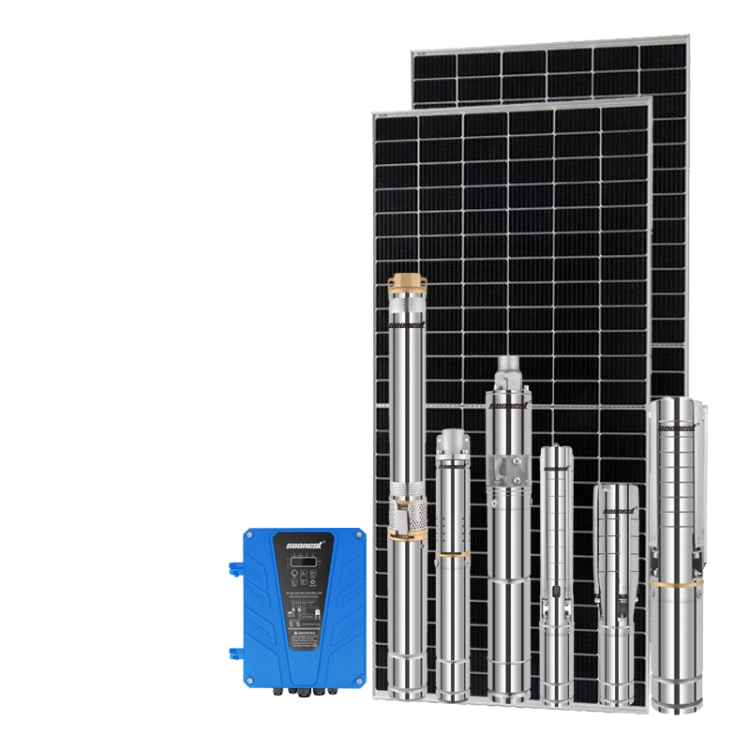
Request the model-specific curve at the calculated head, the controller input voltage range, starting behaviour, dry-run protection details, and acceptable immersion or installation conditions. The product family includes selected submersible versions; do not assume a shared IP rating, head, or flow for every variant. A drawing of the tank and pipe route should accompany the well test.
For a three zone farm, the sizing of storage and scheduling must go hand in hand. The tank fill time of six hours of productive pumping may exceed the highest instantaneous rate of any of the zones, but the outlet of the tank and the distribution to that zone must be able to cope. While there are many other pieces of equipment in the solar home applications range for use on remote systems, the criteria for choosing a pump are best measured by the amount of water that it delivers on a daily basis rather than the peak outlet flow of the pump.
Commission Against Water Delivered, Not Just Motor Operation
Record log water level, array voltage, pump current, tank volume gain and hours of operation for a typical day during commissioning. Measure the time to fill the tank to the top using the longest planned pipe run and with filters in place. If the motor is running but the tank is not gaining water as predicted then check for drawdown, leakage, blocked filters, worn impellers and short pipe diameter before adding more panels.
Two simple mistakes to watch out for in the field. The appearance of clear water in the first sample taken from a sand-filled tank does not mean to assert that sand will not damage the pump after sustained pumping. A float switch mounted too low means that the tank will overflow before the controller can stop the motor. Check the switch, the dry-run behavior of the controller, and the restart sequence. These are not just labels.
In a wider off-grid farm system design, pumping is generally located near other farm loads. When assessing a shared array or backup generator, try to keep the water duty separate from cold storage and lighting loads.
When Direct Solar Pumping Is the Wrong Arrangement
A battery-free daytime pump may not be the best solution for sites with widely fluctuating well yields, that need water pressurized at night or simply don’t have sufficient space for a suitable size tank. An AC-backed solution or separate storage & booster set may be more reliable, with due consideration given to operating costs & maintenance.
Kürzlich supply solar water pumping systems and other solar systems. Useful information to ask for when placing an inquiry would be the measured well drawdown, daily water requirement, proposed pipe layout, tank height, average seasonal solar radiation and connection to grid or generator. With this information a pump curve can be matched to the actual duty required as opposed to just a headline from a catalogue.
Compare tank gain to demand before acceptance. A test shortage becomes a shortage as dry-season drawdown increases.
FAQ (häufig gestellte Fragen)
Can a solar water pump run without a battery?
Yes, a direct-solar configuration can pump water during useful daylight hours and store water in a tank. Verify the required controller, array and daily volume for your specific site. Additional batteries or AC support may be required to pump water outside of the solar collection window.
Is maximum pump head enough to choose a well pump?
Maximum head is normally measured at a different flow to maximum flow. Use the pump curve to calculate the actual flow delivered at the calculated Total Dynamic Head, and then allow for drawdown and pipe losses.
Why does a solar pump stop and start on a clear day?
Intermittent shade, low array voltage, dry-run protection, a float-switch fault or blocked intake all can cause the equipment to cycle. Monitor the controller status and array voltage. Check the water level and switch status before replacing equipment.