To select a 48V or 51.2V LiFePO4 battery, one must consider the loads to be backed up up, the number of hours of backup required, the DC voltage window of the inverter and the limiting factors of the battery: its usable energy and its current limits. Only choosing a battery by ampere-hours does not guarantee that there is actually enough energy stored to start a pump, to run a refrigerator or to correctly communicate with the inverter. First, the backup circuit has to be defined and the load curve transformed into kWh and kW. Then, a corresponding battery configuration can be selected.

Conclusiones clave
- Power from battery in kW and stored energy in kWh has different answers. Maximum simultaneous load and runtime.
- A 48V battery and a 51.2V battery are not interchangeable. You need to check the supported voltage range and the charge parameters of the inverter.
- LiFePO4 chemistry is suitable for stationary storage but temperature, DOD, charge rate and BMS settings influence effective performance.
- Check selected capacity vs. CAN/RS485 communication, connection in parallel, space and cable protection.
Start with the Protected Loads
Sizing a home backup power system becomes a lot more clear when you separate the backup power controller from the rest of the home power controller. The critical loads in your home may include refrigeration, some lighting, some computer and communication equipment, some medical equipment, a water pump and a few other sockets. Most electric heating, large water heaters, ovens and vehicle chargers will typically be so dominant that they are typically excluded from critical loads in their own right.
Write down three values for each protected circuit: running power, starting or surge behavior, and expected daily runtime during an outage. A refrigerator may have a modest average demand but a compressor-start event. A pump may run for only a few minutes but require a higher starting allowance. The inverter must handle the instantaneous event; the battery must supply the required DC current without exceeding its BMS limit.
Why kW and kWh Must Stay Separate
Power is energy delivered over time, and energy is amount of stored fuel. A 10kWh battery bank has 10kWh of usable energy in it. That means you could use 2kW for 5 hours before you’d start to run into problems from energy losses and limits on how the battery is operated. However, a 10kWh battery bank is not necessarily a 10kW power source. The maximum discharge current, inverter rating, temperature, state of charge, and other battery characteristics all affect how much power is actually available.
To provide a rough estimate of runtime for a protected load, multiply the running load by its runtime and then add a buffer for losses during charging and other instances where power may not be fully available. This figure can then be refined based on the specifics of the battery, inverter, ambient temperature, discharge profile, and load behavior. The result should not be misrepresented as actual runtime.
Choosing Between 48V and 51.2V Platforms
The label for the voltage refers to the battery platform, not to the complete system design. The inverter must support the nominal voltage and the charging voltage of the battery and the BMS communication must be recognized by the inverter / energy-management controller. For a 51.2V LiFePO4 configuration a 16-series cell configuration is typically assumed. In contrast to that a 48V system might use a different nominal voltage convention. The exact nominal voltage, charge voltage, and operating limits depend on the selected battery and inverter configuration and must be matched before installation.
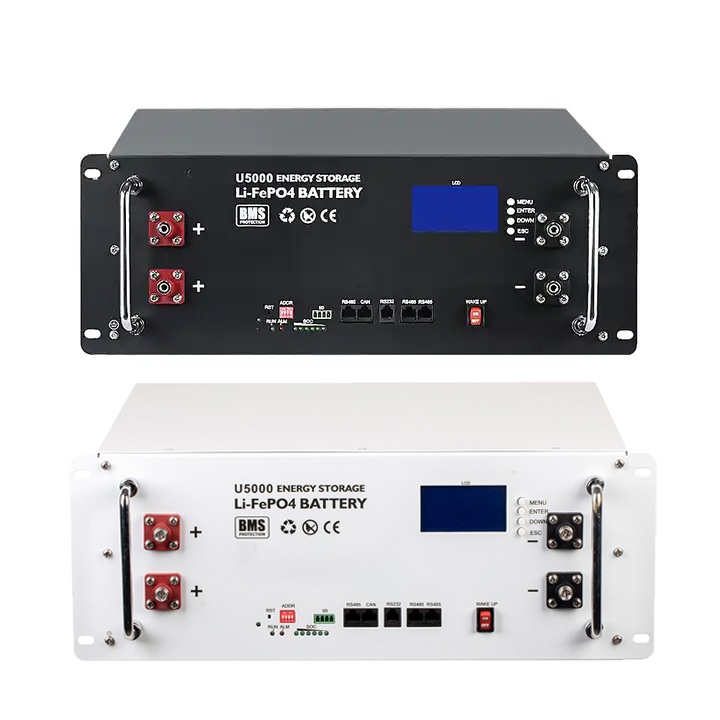
El SOONEST 48V/51.2V LiFePO4 home energy storage battery is available in different capacities such as 5kWh, 15kWh, 17.5kWh, 20kWh and 30kWh, in 48V or 51.2V system versions. The battery is equipped with integrated BMS protection. The communication options are CAN or RS485. Please ensure that capacity, voltage, usable power and communication options of the battery match the inverter you select before a quote can be provided to you..
A Sizing Table That Exposes the Real Decision
Instead of an imaginary all-load case which in reality will never occur, the calculation has to consider the worst practical case. And whereas the daily energy of a small pump or compressor might be small, its starting behavior could have a major impact on the smooth transfer of a backup system.
| Sizing field | What to record | Common mistake |
| Critical running load | Simultaneous watts on the backup board | Adding every appliance in the house |
| Starting demand | Motor, compressor, or pump transient | Using only the steady-state wattage |
| Required runtime | Hours for each priority circuit | Assuming all loads run for the same time |
| Usable battery energy | kWh available within the agreed operating window | Treating nameplate kWh as fully usable |
| Voltaje de la batería | 48V or 51.2V platform and charging range | Selecting a voltage from the inverter label alone |
| Comunicación | CAN, RS485, or supported protocol | Leaving BMS communication for commissioning |
| Expansion plan | Number of parallel units and identical conditions | Mixing different capacities or states of charge |
How the BMS Changes the Usable Result
The battery-management system monitors cell voltage, temperature, current, and protection limits. It may reduce or stop charging when the battery is full, too cold, too hot, or outside its permitted voltage range. It may also limit discharge current when the state of charge is low. This is why an inverter can display available PV or a full battery icon while the actual charge or discharge power is restricted.
The battery’s protection functions include overcharge, over-discharge, overcurrent, short-circuit, overtemperature, low-temperature protection, cell-voltage monitoring, and balancing. Overcharge, over-discharge, overcurrent, short-circuit, overtemperature, low-temperature, cell-voltage monitoring and balancing – all of these are to protect the battery and are not part of the capacity. Please ask for the exact limits of the BMS as well as the alarm behavior for the respective configuration. This is particularly important if the backup load contains a motor, or if several battery units are connected in parallel.
Installation and Expansion Checks That Matter
Store the battery in a location where temperature, clearance, ventilation, service access and cable protection can be controlled. While the thermal characteristics of LiFePO4 chemistry make it suitable for stationary storage applications, no chemistry alleviates the need to comply with the environmental and electrical limits of the manufacturer’s product. A storage cabinet is not a general indoor storage box and locations with heat, condensation, dust or flood exposure are not general indoor locations.
It’s also important to perform an identity check for parallel expansion of batteries. Only batteries of equal voltage and capacity, with matching firmware and similar state of charge should be mixed and matched as required by the manufacturer. Otherwise, the unequal units may exchange large currents for balancing, or even trigger overcharge/overdischarge protection before serving the intended load. Record the identities of the individual units, the cable lengths, the breaker sizes and the communication addresses.
For a complete PV-backed system, evaluate the Soonest battery together with the inverter, PV array, charging current, backup reserve, and household load profile.
When a 48V or 51.2V Battery Is Not the Right Answer
A number of considerations mean this platform is not suited for homes with high continuous loads, with very large three-phase loads or with a backup requirement that results in very high DC currents which exceed the capacity of the inverter and associated cables of the chosen design. Such higher energy projects are likely to require a completely different battery structure or a larger system design that can be supplied by a number of small units operating in parallel. They will also require consideration of current and communication between the various units.
Wrong. Sizing a battery from the wattage of your solar panels is wrong. A big solar array on a small battery will fill up the battery in no time but will not generate any nighttime power or increase your inverter output power. A large battery on a small solar array will take too long to recharge after a power outage. Size your battery to the load, to its time of use and to its recovery time.
The same load-profile discipline used in planning a commercial energy-storage system applies at household scale: identify when energy is used, which loads have priority, and how the system recovers after a discharge event. The equipment changes, but the sizing logic does not.
Preguntas frecuentes
Is a 51.2V battery better than a 48V battery for home backup?
Neither voltage is inherently better. Both must be compatible with your inverter, your charging profile, your BMS communication, your overcharge and over-discharge protection, and your batteries. Check for nominal voltage, maximum charge voltage, low voltage cut-off, etc. and communication protocol before purchasing either of these systems to connect to your batteries.
How many kWh are needed for a one-day home backup?
Unfortunately, there is no generic number that can be used here. Add up the power of all the circuits that you want to protect during the period in question. Subtract the inverter efficiency, add a safety reserve, consider the battery temperature, take into account the depth of discharge that you are allowed to apply to the battery and its aging characteristics. Discretionary loads should not be included in such a calculation where the intention is to power essential loads.
Can two LiFePO4 batteries with different capacities be connected in parallel?
Manufacturer must support such configuration and provide appropriate balancing, protection and communication functions. Different capacities or even different states of charge might cause unequal sharing of current. A matched set of batteries that can be run in parallel with well-documented rules of parallel operation is much easier to verify and to maintain than a set of random batteries.
A Better Purchase Specification
Provide the inverter model, backup-board load list, largest starting load, required runtime, daily PV estimate, installation environment, desired reserve, and expansion plan. Then ask the supplier to confirm the exact 48V or 51.2V configuration, usable energy, maximum current, BMS protocol, communication cable, protective devices, and parallel limits. Más pronto supplies solar batteries, inverters, panels, and related PV products; a complete load brief gives the final capacity a defined job.