Un onduleur hybride monophasé est généralement le choix le plus propre lorsque votre maison utilise déjà un service monophasé de 220/230 V et que vous souhaitez une alimentation de secours pour un chargeur de véhicule électrique, une pompe à chaleur, l'éclairage, la réfrigération et les appareils électroménagers courants.
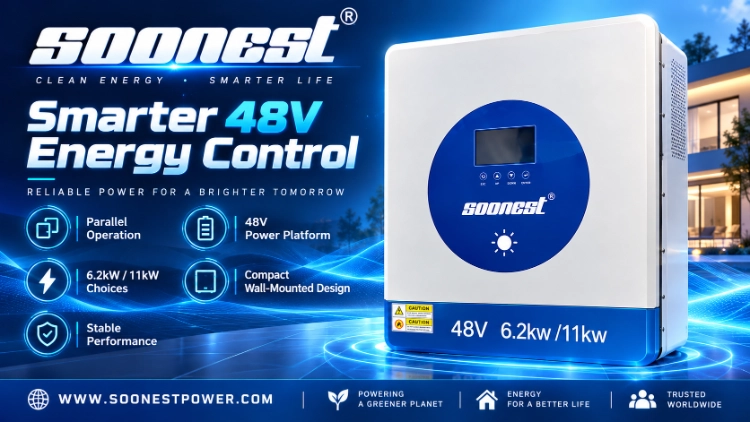
Bientôt conçoit et fabrique des onduleurs solaires, des systèmes de stockage au lithium, des systèmes de refroidissement solaire et des produits photovoltaïques connexes pour les maisons et les sites commerciaux légers. En savoir plus à propos de l'entreprise est utile lorsque vous souhaitez vérifier le fabricant avant de comparer les spécifications électriques. Pour cela, placez le Onduleur solaire hybride monophasé IP65, une unité hybride de 3,6 kW à 10 kW avec protection IP65, modes de fonctionnement solaire/réseau/batterie, prise en charge de l'entrée PV pour les panneaux modernes haute puissance, communication BMS, surveillance Wi-Fi et extension parallèle pour les projets de plus grande envergure.
Ce n'est peut-être pas le choix le plus glamour, mais pour un électricien, l'essentiel est de sélectionner un onduleur adapté au tableau électrique et aux charges à alimenter. Le triphasé présente des avantages pour les gros moteurs, les ateliers et certains bâtiments commerciaux. Une maison équipée d'une seule borne de recharge pour véhicule électrique et d'une seule pompe à chaleur n'a pas besoin d'une conversion triphasée pour une meilleure gestion de la consommation. Cependant, en cas de coupures fréquentes, il est judicieux de privilégier la protection des appareils essentiels au confort et de recharger le véhicule électrique lorsque l'énergie solaire ou le réseau électrique sont disponibles.
Quand un onduleur hybride monophasé est-il plus judicieux ?
Commencez par votre installation électrique actuelle. Changer de fournisseur peut engendrer des coûts supplémentaires, des démarches administratives et des travaux sur le tableau électrique. Parfois, c'est nécessaire, mais souvent non.
Service domestique existant 220/230 V
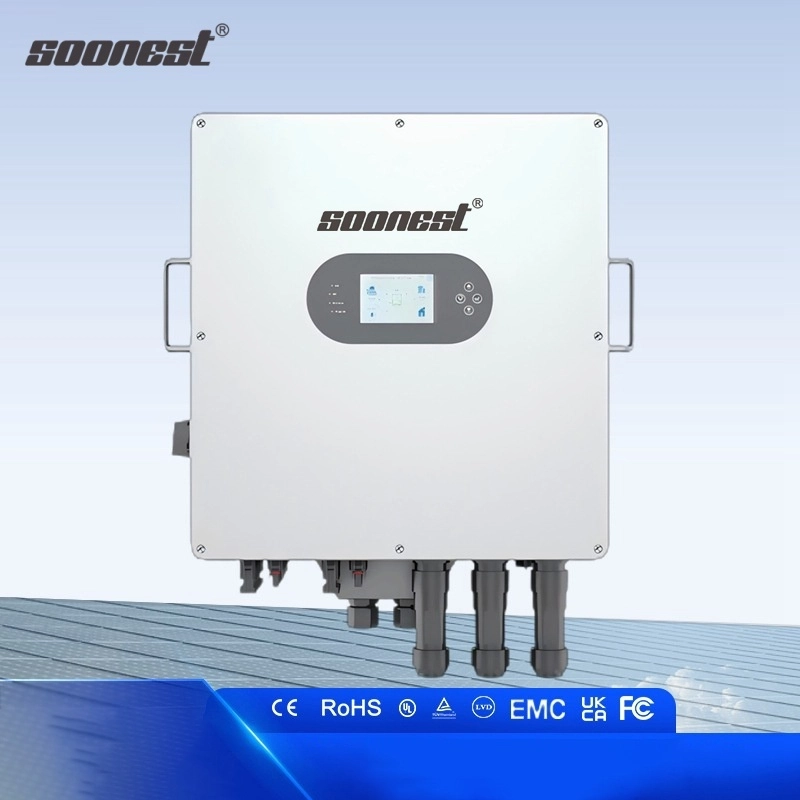
De nombreuses habitations utilisent une alimentation monophasée de 220 V ou 230 V. Si vos appareils électroménagers, votre pompe à chaleur, vos prises, vos luminaires et votre circuit de charge sont tous conçus pour cette alimentation, un onduleur compatible simplifie l'installation de secours. C'est là que le matériel compatible prend tout son sens, sans nécessiter une mise à niveau complète de l'installation électrique. Onduleur solaire hybride monophasé IP65 Il est conçu pour un fonctionnement hybride monophasé 220 V, il peut donc s'intégrer naturellement dans ce type de système résidentiel lorsque les charges sont inférieures à sa capacité nominale.
La recharge des véhicules électriques en tant que charge programmée
La recharge d'un véhicule électrique à domicile ne doit pas être considérée comme celle d'un réfrigérateur. Selon les recommandations du Département des Transports américain concernant la vitesse de recharge, la recharge de niveau 2 utilise généralement une tension de 208 à 240 V CA et une puissance typique de 7 à 19 kW. Dans de nombreux foyers, il est conseillé de recharger le véhicule électrique pendant la journée, de limiter l'intensité du courant ou d'interrompre la recharge lorsque la batterie est faible.
Priorité de charge de la pompe à chaleur
Les pompes à chaleur sont efficaces, mais peuvent fonctionner pendant des heures, voire toute la journée. On estime que, dans de nombreux cas, le chauffage et la climatisation représentent près de la moitié des dépenses énergétiques d'un ménage. Les pompes à chaleur air-air produisent beaucoup plus de chaleur qu'elles ne consomment d'électricité. En théorie, c'est donc une bonne nouvelle pour les économies d'énergie d'un ménage équipé d'une pompe à chaleur air-air. Cependant, il est important de prévoir les pièces, les températures de consigne et les heures de fonctionnement de la pompe à chaleur. Refroidir une chambre la nuit est différent de refroidir toute la maison pendant la journée.
Quand devriez-vous envisager un système triphasé ?
Le triphasé n'est pas systématiquement meilleur. Il l'est lorsque les besoins en énergie ou les installations techniques du bâtiment le requièrent. Avant d'entreprendre les travaux, évaluez le problème que vous souhaitez résoudre.
Charge de pointe simultanée plus élevée
Si le chargeur de véhicule électrique, la pompe à chaleur, le chauffe-eau, la pompe, le four et les outils d'atelier fonctionnent simultanément, le problème est probablement lié à la surcharge, et non à un problème de phase. Vous pouvez réduire cette surcharge grâce à une planification de la consommation, un tableau de distribution dédié aux charges critiques et des limitations de courant pour le chargeur. Si la surcharge simultanée dépasse toujours la capacité de l'onduleur, une installation électrique plus puissante ou différente peut s'avérer nécessaire.
Moteurs triphasés ou ateliers
Certaines habitations comprennent des ascenseurs, des machines, des pompes d'irrigation ou du petit matériel commercial. Si ces appareils fonctionnent en triphasé, les raccorder de force à un système monophasé de secours est généralement une erreur. Il est préférable de séparer ces circuits ou d'opter pour un système triphasé. L'objectif n'est pas de débattre de la question des onduleurs, mais d'éviter les coupures de moteur intempestives.
| Charger ou appareil | Point de données public | Signification du design | Vérification de l'acheteur |
| Recharge de niveau 2 pour véhicules électriques | 208-240 V CA, typique 7-19 kW, 4-10 heures pour un VEB de 60 kWh à 80 %. | Un chargeur peut égaler, voire surpasser, de nombreuses charges de secours domestiques. | Définissez les plages horaires de charge, les limites de courant et la priorité de sauvegarde. |
| Pompe à chaleur air-air | Le chauffage et la climatisation représentent près de la moitié d'une facture énergétique annuelle typique de 1 900 $ ; les pompes à chaleur air-eau peuvent fournir jusqu'à 3 fois plus d'énergie thermique. | Une pompe à chaleur peut être efficace, mais elle nécessite tout de même de longues heures de fonctionnement. | Utilisez les données de charge par pièce et évitez les suppositions concernant la consommation d'énergie de toute la maison. |
| unité monophasée IP65 | 3,6 kW, 5 kW, 6 kW, 8 kW et 10 kW ; courant de charge/décharge jusqu'à 200 A. | Fonctionne de manière optimale lorsque l'alimentation électrique du domicile et les charges sélectionnées sont monophasées. | Vérifier la tension du réseau, la puissance de crête (kW), la puissance d'entrée photovoltaïque, la tension de la batterie et la compatibilité du système de gestion de batterie (BMS). |
Coût de la mise à niveau des services publics et du câblage
La mise à niveau d'une installation triphasée peut nécessiter l'approbation du fournisseur d'électricité, un nouveau compteur, des modifications du tableau électrique, une refonte du système de protection et des travaux d'installation plus importants. Sur les marchés où le réseau électrique est déjà instable, cette mise à niveau peut même s'avérer impraticable. Il est donc essentiel d'évaluer le coût total de la modification électrique avant de la considérer comme la solution la plus avantageuse. Parfois, un onduleur hybride monophasé correctement dimensionné, avec des règles de charge clairement définies, offre un meilleur résultat.
Comment dimensionner l'onduleur et la batterie ?
Le dimensionnement doit suivre un ordre de décision précis : puissance de pointe, consommation journalière, autonomie, puis recharge solaire. Inverser cet ordre peut faire grimper rapidement le coût des batteries.
Puissance de pointe (kW) avant la consommation journalière (kWh)
La puissance de crête (kW) indique si l'onduleur peut démarrer et alimenter la charge. La consommation journalière (kWh) indique l'autonomie de la batterie. Pour les habitations équipées de bornes de recharge pour véhicules électriques et de pompes à chaleur, il est important de distinguer les besoins en alimentation de secours des besoins non essentiels. L'éclairage, un réfrigérateur, le Wi-Fi, quelques prises et un circuit de confort économe en énergie peuvent être indispensables. La recharge d'un véhicule électrique pendant une coupure de courant est généralement optionnelle, sauf si le site présente un besoin spécifique en matière de mobilité.
Courant d'entrée PV et de batterie
La page produit indique un courant d'entrée PV double de 22 A, la compatibilité avec les panneaux haute puissance et un courant de charge/décharge jusqu'à 200 A. Ces valeurs ne sont pertinentes que si le reste de la conception est adapté : tension de la chaîne PV, tension de la batterie, section des câbles, choix du disjoncteur et température ambiante. Renseignez-vous sur la compatibilité de ces caractéristiques avec votre modèle et votre parc de batteries.
Communication et planification parallèle du système de gestion des bâtiments
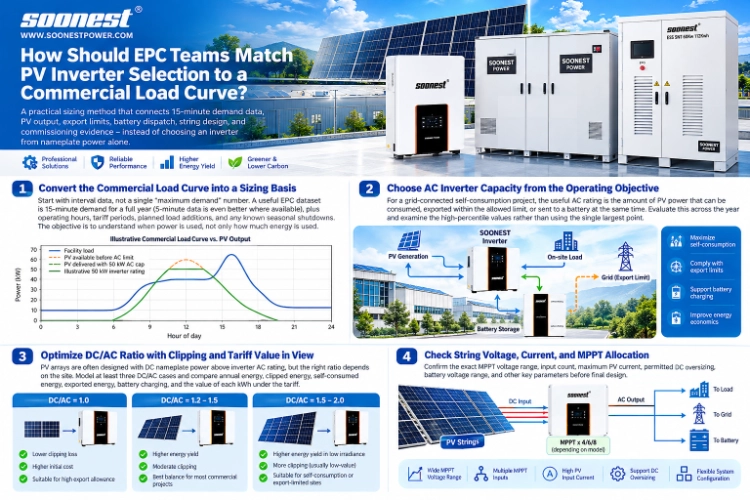
L'onduleur prend en charge la communication RS485/CAN avec les batteries au lithium compatibles et jusqu'à 10 unités en parallèle pour les projets de grande capacité. Cela offre une marge d'évolution, mais la conception en parallèle doit être planifiée dès le départ. La marque de la batterie, le protocole, l'espace disponible dans l'armoire, le firmware et les paramètres de protection doivent être confirmés avant l'installation. C'est une liste de vérifications fastidieuse. Les listes de vérifications fastidieuses permettent d'éviter les pannes.
Conclusion
Choisissez un onduleur hybride monophasé si votre alimentation électrique domestique est monophasée, si votre borne de recharge pour véhicule électrique est programmable et si votre pompe à chaleur d'appoint est limitée à des zones de confort définies. Optez pour un système triphasé uniquement si le bâtiment présente de véritables charges triphasées, une forte consommation simultanée ou si un projet de mise à niveau est financièrement avantageux. Onduleur solaire hybride monophasé IP65 est un choix résidentiel judicieux car il combine une protection adaptée à l'extérieur, des modes hybrides solaires et réseau, la communication BMS, la surveillance, une conception d'entrée PV moderne et des options de sortie évolutives.
Pour l'approvisionnement, commencez par la liste des charges plutôt que par le plus grand modèle présenté. Indiquez la puissance du chargeur, les données de la pompe à chaleur, les circuits de secours, l'espace disponible sur le toit, la tension du réseau, la capacité cible de la batterie et si vous prévoyez une extension future. contact nous pour demander une configuration qui s'adapte à votre maison au lieu d'une estimation surdimensionnée.
FAQ (questions fréquentes)
Un onduleur hybride monophasé peut-il alimenter une borne de recharge domestique pour véhicule électrique ?
Oui, si le courant de charge est limité et si l'onduleur, la batterie, le câblage et les dispositifs de protection sont dimensionnés pour le mode de charge sélectionné. En cas de coupure de courant, la plupart des foyers devraient privilégier les circuits essentiels et programmer la recharge des véhicules électriques pendant les heures d'ensoleillement.
Le triphasé est-il toujours préférable pour une maison équipée d'une pompe à chaleur ?
Non. Une maison alimentée en monophasé et équipée d'une pompe à chaleur de puissance moyenne peut généralement se contenter d'un système d'appoint monophasé. Le triphasé est plus approprié lorsque le bâtiment est équipé de moteurs triphasés, présente des pics de consommation importants ou fait l'objet de travaux électriques de type commercial.
Que devez-vous vérifier avant d'acheter ?
Confirmer la tension du réseau, la puissance du chargeur, la charge de fonctionnement de la pompe à chaleur, la puissance de crête (kW), la consommation journalière (kWh), le protocole de batterie, la conception de la chaîne photovoltaïque, l'emplacement d'installation et accès au serviceCes contrôles permettent de déterminer si le système fonctionnera correctement lors de pannes réelles.