Cold is harder to buy than light, and anyone who’s sized a clinic’s vaccine store knows it. A village happily running LED lamps and a television off a small solar kit still can’t keep vaccines cold or fish frozen past sunset, because refrigeration runs its compressor through the hottest hours of the day and its failure mode isn’t a dark room, it’s a wasted box of medicine nobody can replace until the next container. Which is exactly where solar-fridge procurement goes most wrong. Buyers match the appliance to the sunniest hours and forget the night exists, or they drop a grid-tied “solar-saving” unit on a site that loses power four evenings a week, and then the box performs like an expensive coincidence. The category hides three genuinely different machines behind one innocent phrase, solar refrigerator, and the right one depends on a single fact about the site: how much of the grid can the site actually count on?
Definitions come first here, since they decide everything downstream. What counts as a true DC refrigerator? One that runs its compressor on direct current, 12V or 24V typically, straight from panels and a battery, skipping the inversion step that quietly taxes a slice of every watt you produce. An AC/DC hybrid unit drinks DC while the sun is up and falls back to mains automatically, mid-afternoon cloud or no mid-afternoon cloud. The solar-thermal vacuum tube machine is a third animal altogether, still tethered to the grid, saving part of the bill through a thermal collector instead of through panels. One phrase, three different purchases, and the price sheets happily mix them.
Which Machine Fits Which Site
The whole decision compresses into three rows, and every argument after this is somebody’s sales angle.
| Site condition | Machine that fits | Why |
| No grid, or grid fails daily | DC fridge plus panels plus battery | Cold survives every outage, the battery is the whole plant |
| Grid reliable, bills high | AC/DC hybrid that auto-switches to solar | Solar carries daytime cooling, mains takes the night, no battery bank |
| Grid always on, tariff steep, wall space | Vacuum tube solar-thermal split unit | Saves 30% to 70% of electricity with no panels, no batteries, still grid-tied |
Each row deserves its honest asterisk, though. The off-grid route costs more on day one precisely because the battery and array are doing the work the single word refrigerator pretends to do alone. Price the box without them and you’re comparing one number against three, which isn’t a comparison. The hybrid route saves approximately nothing on a site where the tariff is already cheap and the grid never fails, and its bright sunny-day claim collapses on a shaded roof like everything else in solar does. The vacuum-tube machine, a thermal collector bolted onto a normal split conditioner, saves 30% to 70% against ordinary units but never once leaves the mains. That’s a bill-reduction product being sold in a reliability category. Know which column your buyer actually lives in before quoting.
Reading a DC Fridge Datasheet Without the Brochure
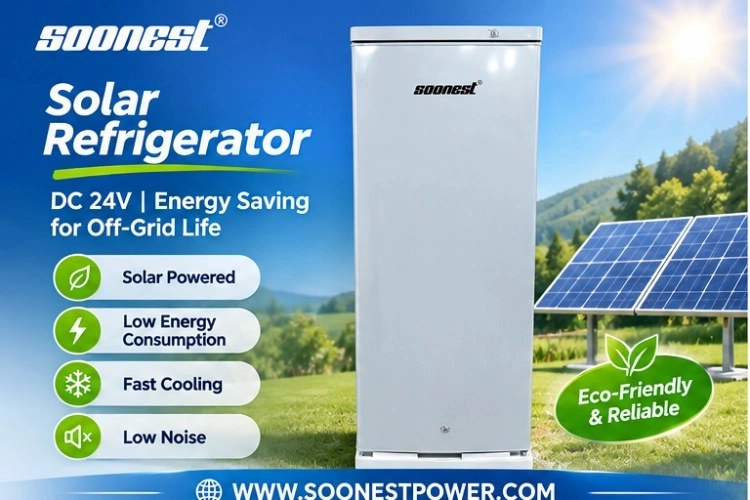
The SOONEST solar refrigerator-freezer line works AC/DC, with 12V/24V DC operation on a BLDC (brushless DC) compressor, freezing down around minus 18 to minus 19 degrees with 30-degree ambient outside, and grid consumption roughly 70% lower once solar pulls its share. Useful numbers, genuinely. But the specs that decode the whole category hide underneath that paragraph, in the lines most sales sheets would rather skip.
What are the four worth your time? One: the low-voltage cutoff. The unit switches itself off when input voltage sags, which flatters the compressor’s obituary and quietly cheats the buyer, because the fridge’s real usable battery band ends wherever the cutoff sits, and a clinic discovers this by thermometer rather than by datasheet. Two: insulation thickness, which on this family runs 110 mm of foam, and that’s where the night is actually survived. Thick walls buy hours, thin walls buy showroom floor. Three: the compressor’s own electronics, since a fully hermetic unit with integrated control behaves far better in heat, and heat is the operating condition everywhere these boxes sell, rated across a -10°C to 55°C span. Four: refrigerant, where R134a remains the common answer in this class. The refrigerator-freezer product page keeps the family’s configuration in table form, and four lines requested from every vendor, in writing, standardizes a price comparison that otherwise isn’t really one.
The company behind this line has skin in the whole cold chain, and that matters when equipment faults three hundred kilometres from a depot. Zhejiang SOONEST New Energy has spent 20 years building panels, inverters, storage and solar appliances for off-grid and weak-grid regions across Africa, the Middle East and Asia, with CE, ROHS, SONCAP, UL and ISO paperwork already in place. Why fussy about paperwork? Because a fridge that faults needs parts, protocols and papers arriving together, not one at a time. The official website indexes the full appliance range if you want to see how the pieces sit side by side.

Sizing Around the Compressor, Not the Label
“Solar powered” printed on a label answers nothing at all. The energy balance does the answering. Average the compressor’s draw across its duty cycle, multiply by the worst winter day the site actually sees, and that number is your battery, sized for the cloudy run the site will genuinely suffer through, not the brochure’s heroic two-day autonomy on one bright December morning. Panels then refill that battery inside the location’s real sun hours, which is why two identical clinics in two different countries leave the same factory with different arrays bolted to the quote. The same compressor logic repeats through the DC solar air conditioners in this catalog, so a clinic or cold room assembled from one supplier keeps its voltages and charging gear inside a single family, one troubleshooting manual instead of four arguing ones.
Mistakes That Repeat Across Import Orders
Mistake one is buying the freezer without the freeze, and clinics get burned by this. A clinic stores vaccines at two to eight degrees, while a fish business wants minus 18 held steady through a 35-degree afternoon. The first need is buffer mass and patient control; the second is compressor headroom plus that thick insulation from earlier. Vendors offering one box for both requirements are selling a compromise with a nice powder-coat finish, and both buyers lose.
Mistake two is forgetting service radius, the quiet killer. A BLDC compressor with integrated electronics is a wonderful citizen right up until it faults, and the clinic that waits four weeks for a single control board has discovered the real specification of a solar fridge, which is whatever the local dealer keeps on the shelf. African and Middle Eastern buyers lean toward suppliers whose certification travels ahead of the container for exactly this reason, SONCAP files and CE papers arriving before the box rather than arguing with it at the port, part of a certified range that runs from panels and hybrid inverters right through to the fridges themselves.
The short version of a qualified inquiry? One honest paragraph of site truth: the outage calendar, the ambient extremes, exactly what gets stored inside, and who services the box when it’s 40 degrees out. Sent across to the contact page, that paragraph filters vendors faster than any price sheet ever printed.
FAQ (questions fréquentes)
Is an AC/DC Hybrid Fridge Better Than a DC Unit With an Inverter?
On a site with a real grid behind it, usually yes, and the arithmetic is short enough to do at the desk. Running 220V mains through an inverter to feed a DC fridge pays back, in conversion losses, the exact efficiency the DC machine was bought to keep, and the hybrid’s native automatic switching does the same job without the extra box on the wall. No grid at all? Then a pure DC fridge on panels and battery is simply the fewer-machines answer, and fewer machines is what an unattended site can realistically keep running.
How Much Does Solar Actually Cut a Fridge Bill?
Well-sized, roughly 70% off grid consumption in normal service for the solar DC and hybrid installations, and a true off-grid build deletes the bill entirely along with the outages, which was rather the point of buying it. Showroom percentages won’t survive a real winter, though. That’s why the sizing arithmetic from two sections back matters more than any headline number painted on a trade-show banner.
Does a DC Refrigerator Need a Battery if It Has Panels?
For any cold that outlives sunset, yes, and there’s no elegant workaround. The compressor stops the instant input voltage drops, so the battery is what carries the box through night, rain and dust storms alike. Some small chest units coast through short cloudy stretches on thermal mass alone, which is a camping answer, not a clinic answer. A clinic or a fish locker needs battery capacity sized to its worst week, not its luckiest.