A solar cold room for fish, meat or dairy must be sized around product load, pull-down requirements and the hottest conditions at the site.
Start with the daily throughput and the temperature of incoming stock. Calculate the cooling energy, then size the array for the least sunny month and the battery for the hours without solar production.
Insulation, door traffic and ambient temperature all affect the final system capacity.
Once these figures are clear, a supplier can prepare a useful configuration and quote.
Where the Cold Escapes
Five places. The room loses capacity from all of them before a crate goes in.
Walls and roof. 100 mm polyurethane is the standard for minus 18 in a hot climate. Halve that and the compressor runs all afternoon for nothing.
Outside air next. Design for 40°C. Coastal West Africa, the Gulf, half of Southeast Asia. Months above 35. A room designed on a mild December week fails in May.
Doors. Cold leaves, hot arrives. Strip curtains cost nothing. Four deliveries an hour without one needs 15 to 20 percent more capacity.
Fish arrives at 25 to 30°C and has to reach minus 18. That fall from arrival temperature to storage temperature is the pull-down, and it is what sizes the compressor. Holding temperature afterwards is the easy half.
Fans, lights, defrost. Nobody counts them. They never stop.
Four Numbers, Then a Quote
Volume in cubic metres. Panel thickness you can pay for. Kilos per day, and the temperature they arrive at. Door openings per shift. Ambient design temperature for the hottest month.
Five numbers, really. The last one is free: the month itself. Ask a supplier what ambient he designed for. Watch his face.
| Number to collect | What it decides |
| Volume and panel thickness | Envelope load; 100 mm polyurethane is the standard for minus 18 in a hot climate |
| Kilos per day and arrival temperature | The pull-down, and with it the compressor size |
| Door openings per shift | Without a strip curtain, 15 to 20 percent more capacity |
| Ambient design temperature, hottest month | Compressor capacity and array output both fall as the outside air rises |
| Hours running after dark | Battery bank size; overnight carries about half the daily load |
Anyone quoting without asking these is reading a catalogue aloud.
Turn It Into kWh Per Day
A familiar room. 20 m³, two tonnes of fish, 100 mm panels, 40°C outside. Holding load plus one pull-down lands between 20 and 26 kWh a day at the compressor, once the room is down.
Better panels, shaded roof, strip curtain: a third less. Skip all three and it goes past 30.
Planning arithmetic, not a quote. Your doors and your fish will move it. The method travels: everything becomes kWh per day, then the design runs backwards.
Two numbers break systems. Pull-down kW, because a compressor starting against a warm room draws hard for the first hour. And overnight kWh, because that is what the battery carries with nothing coming off the roof. Compressor cycles drive panel and battery sizing more than most buyers expect.
Panels, Battery, Then the Awkward Part
Array. Daily kWh divided by worst-month peak sun hours, then by system losses — peak sun hours being the full-sun equivalent of a day at that site, the figure that turns daily kWh into array size. Coastal West Africa gets 4.5 to 5.5 in the dry season, less in the rains. So 22 ÷ (5 × 0.75) is 5.9 kWp, or eleven 550 W mono panels and a bit of roof spare.
Battery. Overnight is about half the daily load. Eleven kWh at 80 percent depth of discharge — the share of a bank’s rating a cycle actually uses — wants 14 kWh of bank. LiFePO4, the lithium chemistry rated for thousands of deep cycles, takes that daily at 6,000-plus cycles. Lead-acid will not, not at this duty.
Conversion next. Compressor start is the test. Ask for surge rating and ignore the nominal figure. A unit picked on nominal kW trips on the first hot afternoon and everyone blames the panels.
Then the awkward part. If the arithmetic comes back heavy for one small room, you are looking at the wrong product.
Below Two Tonnes a Day, Cabinets Win
300 to 800 kg a day does not need a walk-in. Four to eight solar freezer cabinets do it better.
One fails, the rest keep the catch cold. A room fails and you have hours, not days.
Cabinets arrive charged. Connect, hold temperature, trade the same afternoon. A room needs insulation, commissioning, and a technician two days up the road.
Demand doubles in a good season. Buy two more cabinets. Try that with a compressor room.
12/24 V DC runs straight off panels and battery. No three-phase. No inverter in the path.
The crossover is not fixed. Heavy door traffic or thin insulation can push a small room’s daily kWh past what a bank of cabinets would burn, and palletised stock above two tonnes a day pushes it the other way. Run the door count before signing the slab.
Freezers Made for This Duty
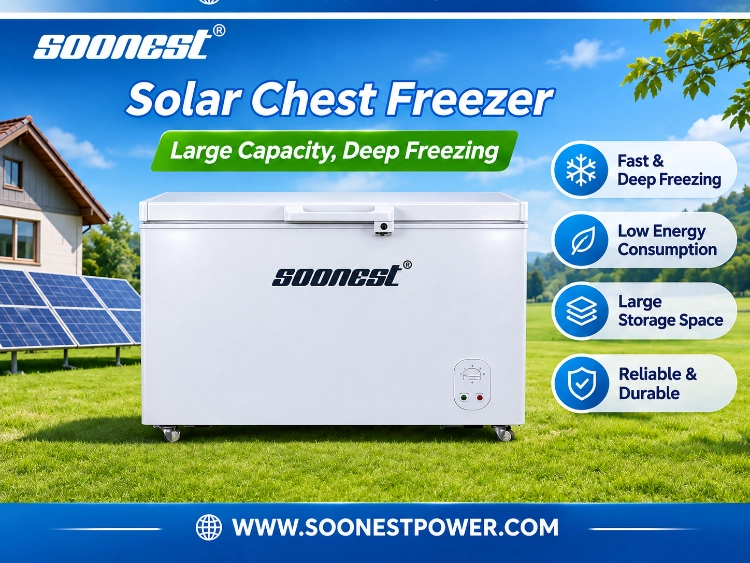
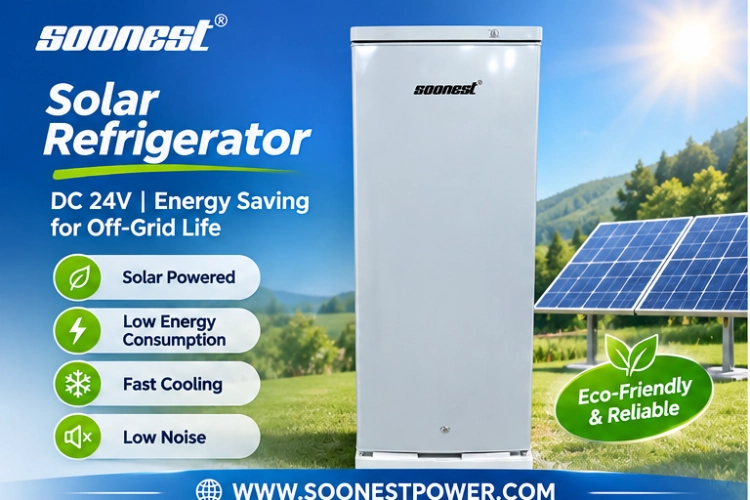
The SOONEST solar refrigerator freezer takes dual AC/DC input and gives solar priority. Grid draw drops by as much as 70 percent wherever a connection exists. BLDC compressor, integrated control electronics, minus 19 at 30°C ambient, 110 mm of insulation. MPPT charge control inside, holding the panels at their most productive voltage. Low-voltage cut-off so the compressor survives a flat bank. Double solid top door, inner sliding glass door.
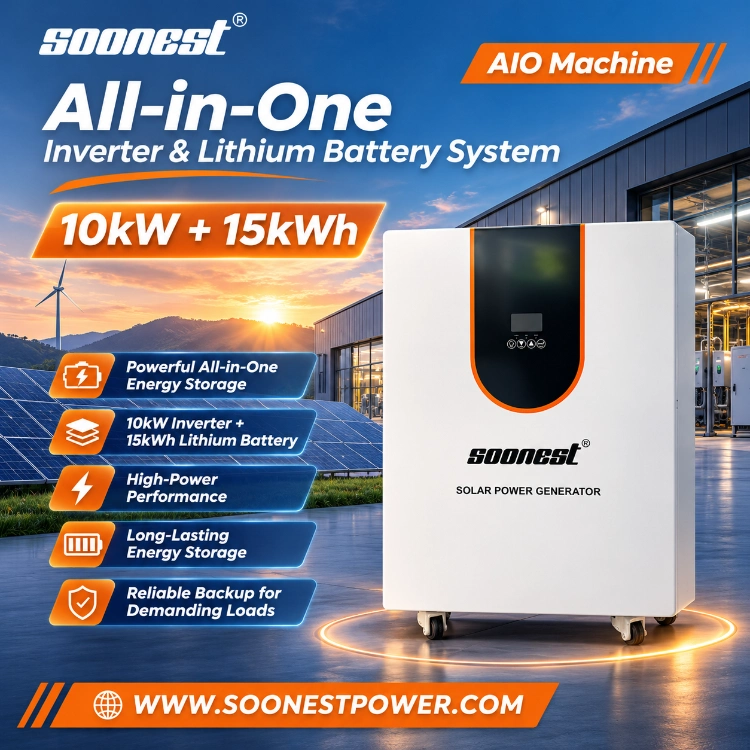
Four cabinets plus a 10 kWh all-in-one storage unit is a complete shop. Cold space, lights, a fan, phone charging.
Where a real room is unavoidable, the same unit runs its AC compressor while the array feeds both and the battery takes the night.
Year Two Is Where Cheap Systems Show Up
Array sized on the sunniest month. Works in February. Dead in August.
Battery in a tin shed at 45°C. Heat kills cells quietly. Shade the box.
Monitoring nobody reads. One dead string, six weeks, spoiled stock.
Doors with no curtains, and a compressor that never rests.
No local technician, no spare controller. A $200 part becomes three weeks of downtime mid-season.
The Bottom Line
Cold chain is a timing business. The hardware exists to get product from the boat to the buyer before the value drains out. Size on kWh. Insulate properly. Keep the batteries where heat cannot find them.
Zhejiang SOONEST New Energy Co., Ltd. builds the panels, cabinets and storage that make up that system. Twenty years in photovoltaics. A 4,000 m² production base in Foshan. More than 50 R&D patents, CE, RoHS, UL, SONCAP and ISO certification across the range, and OEM and ODM programmes for distributors who want their own badge. Send the team daily kilos, room volume and the worst month at your site. What comes back is a configuration, not a catalogue page. The range sits at soonestpower.com.
FAQ
How many panels does a 20 m³ cold room need?
5.5 to 6.5 kWp for the load above. Ten to twelve 550 W modules. Heavy door traffic, thin panels or a 45°C design ambient push that up. Start from kWh per day, never from volume.
Can it run with no batteries at all?
With a big thermal buffer and daytime-only loading, yes. A dedicated DC freezer cabinet runs off the array while the sun is up. Holding minus 18 overnight needs storage. No way around that.
What temperature for each product?
Fish and meat at minus 18 or colder. Dairy and chilled produce at 2 to 6°C, in a separate room. One compressor cannot serve both setpoints properly.
What about a week of heavy cloud?
Output falls to 20 or 30 percent of a clear day. Frozen stock buffers a day or so. After that, a bigger array or a small genset. Both are cheaper to plan before the slab is poured.