
A controller that trips is usually the messenger, not the culprit. The water level fell. The impeller wore thin. A cold morning pushed string voltage past the input limit. Or the box is bolted up where the afternoon sun beats on it all day. On the distributor’s side of the counter, the controller gets blamed first and cleared last, and every replacement sent out prematurely costs the farmer a fortnight of no water plus a shipping bill for the privilege.
Whatever the display shows, it is naming a protection that did its job. It is not handing down a verdict on the electronics. Most trips trace back to water level, pipework, array voltage or heat. Distributors who field these calls put the box at the bottom of the suspect list more often than at the top.
The checks below follow one rule. Diagnose before you buy. They are laid out cheapest first, so you never start with the part that costs most.
Check the Water Before the Electronics
A dry-run fault is not a controller fault. It means no water moved through the pump.
Static water level drops in the dry season. A pump set at 40 metres two years ago may sit above the water table by noon.
It worked all morning, when the level was higher. Nobody noticed, because water arrived.
Drop a line and measure the level, then compare it with the reading from the install day. That number explains more faults than any display code.
After that, the dumb stuff. Somebody finds a blocked intake screen, or the suction pipe has collapsed, or the foot valve stopped holding prime three months ago and nobody looked.
Dry Run That Clears Itself by Afternoon
Good controllers restart themselves several minutes after a dry-run trip.
When somebody is resetting the unit by hand after every trip, the diagnosis has already gone wrong. The protection is behaving; the configuration behind it is not.
Field experience says one of two changes sorts out almost all of them. The pump drops deeper into the borehole, or the dry-run threshold moves up, catching the trip earlier while the motor still has enough cooling left to come back.
Do not disable the protection. A brushless motor run dry for twenty minutes loses its seals. Then the water ends up in the winding instead of the tank.
Overvoltage at Nine in the Morning
This one looks like a controller fault. It is almost always an array problem.
Panel voltage climbs when cells are cold. Take a string that reads 380 V on a hot afternoon. Put a cool, clear morning in front of it and the same string shows 420 V. Sometimes more. The controller reads that voltage and shuts down, which is it protecting itself exactly as designed.
You check this against open-circuit voltage, the number the string produces with zero load drawing on it. It never shows higher than this. Then compare that against the controller’s input limit at the coldest dawn the site will ever see. Never at the average morning. Trips hide inside averages. Averages hide trips.
A string that behaved in June can trip every morning in December.
Nothing replaces hardware here. The fix is in how the string is wired, either fewer panels in series or a different series-parallel split altogether.
People mix up voltage headroom and pumping head constantly. Different quantities, but the sizing calculation has to hold both of them, because both decide whether the finished system performs.
Overload, and the Sand That Was Not There Last Year
An overload trip means the motor pulled more current than allowed. Sometimes that is a failing motor.
In field practice it is a tired impeller more often than a tired motor. Or the borehole has begun running sand, which no one notices until the pump comes up.
Bring the pump to the surface and run a thumb across the impeller’s leading edge. If it feels scored rather than smooth, sand has been eating that pump for months.
A pump running sandy water for a season loses head quietly. The trip comes later, once the level drops and the load climbs with it.
The controller keeps protecting the motor. That is not the same as fixing the well.
High Temperature at Two in the Afternoon
Put a controller in a metal box in full sun and it will trip on a hot afternoon. Then the next afternoon. Ask the farmer what time it trips and you get the same answer every time, which should tell you heat is involved.
Installers who get this right hang the controller where it lives in shade, with airflow across the heatsink. Shade cloth and 30 centimetres of clearance solve more of these cases than a replacement unit does.
A trip in the morning is a different story. Look at the motor then. A pump running at the wrong frequency heats up before the sun gets strong.
When the Controller Really Is Dead
Real death looks different. Real failure you can see: water pooling inside the enclosure, a terminal burnt black, or a storm that put a strike close enough to count. Lightning tends to travel the DC side and kill the controller while the panels stand untouched.
Fit the replacement, then put surge protection on the DC side and earth the whole system the way it should have been earthed the first time.
Keep this boundary tight, deliberately. Widen it and the innocent box ends up replaced instead of the real fault. Move a suspect controller onto a working array and pump for an afternoon; if the trip follows the box, replace it. A fault that stays in the field was never the box.
Lightning strikes the tallest earthed thing it can find.
What the Pump Should Offer

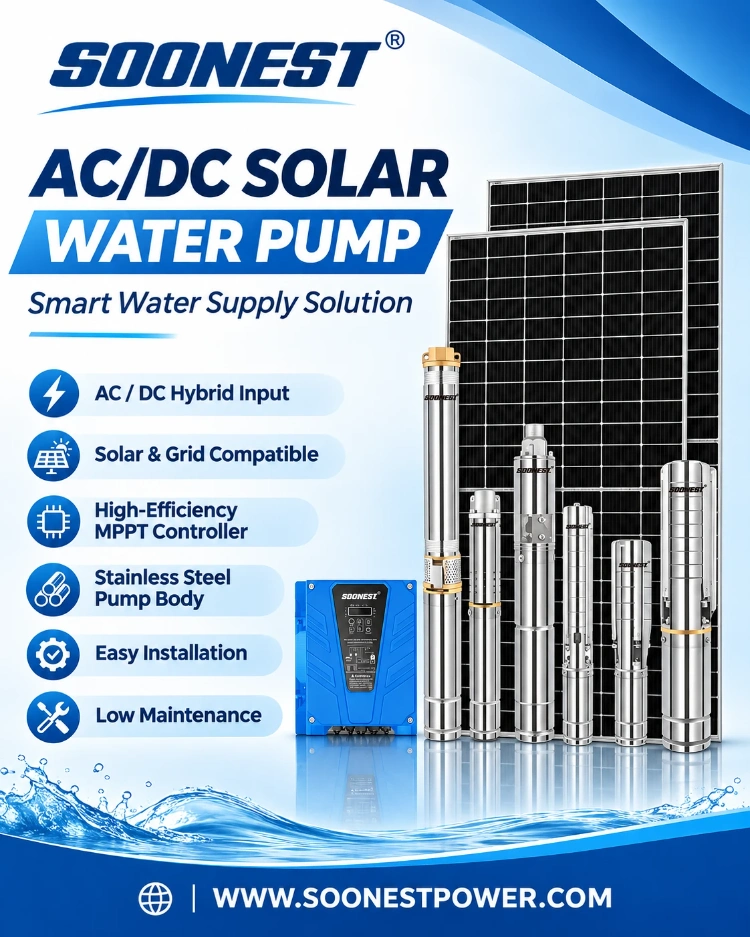
The SOONEST AC/DC solar water pump was specified against precisely this call list, carrying dry run, overload, low voltage, high temperature, reverse connection and speed control as standard protections.
MPPT tracking sits around 85 percent conversion and holds the array at its best voltage. Inside is a brushless permanent magnet motor, chosen because there is no brush pack to service in the field.
The build is aluminium alloy, the windings are resin-cast, and the waterproof rating runs high. In a season that floods the headworks, that waterproof rating is the difference between a pump and a paperweight.
There is deliberately no battery between panel and pump on this system. For the weeks the sky refuses to open, the AC/DC variant just runs from mains or a generator on the same controller.
Where a pump shares a site with a house or a cold room, one array usually feeds an all-in-one storage unit. Sites like that get fewer boxes on the wall and one manual instead of three.
A Fault-Finding Order That Saves Money
Water level first. Pipework and valves next. Then array voltage against the controller limit. The motor comes last, measured at its terminals.
| Symptom | What it usually means | First check |
| Dry-run trip that clears by afternoon | Water level fell below the pump | Drop a line, measure, compare with the install day |
| Overvoltage trip on a cool morning | Cold cells push string voltage past the input limit | Open-circuit voltage against the limit at the lowest morning temperature |
| Overload trip as the level drops | Worn impeller or sand in the water | Pull the pump, inspect the impeller leading edge |
| High-temperature trip every afternoon | Controller mounted in full sun | Shade cloth and 30 centimetres of clearance at the heatsink |
| Dead after a storm | Lightning through the DC side | Water in the enclosure or a scorched terminal; replace and add surge protection |
Only then open the controller. In most field reports, the controller is the fifth suspect and the first thing replaced.
Keep a note of what tripped, and when. Three trips at eleven in the morning is a water story. Three at two in the afternoon is a heat story.
The clock is evidence. Most people never look at it.
The Bottom Line
Most pump failures are water problems, pipe problems or voltage problems wearing a controller-shaped mask.
Zhejiang SOONEST New Energy Co., Ltd. builds pumps and panels for these installations. Zhejiang SOONEST New Energy has worked in photovoltaics for two decades now, producing out of a 4,000 m² base in Foshan with over 50 R&D patents behind the range. Certification covers CE, RoHS, UL, SONCAP and ISO, and OEM and ODM programmes run for distributors and EPC teams as a matter of routine.
The technical team works from three numbers: where the site is, what the head measures, and the daily litres you need moved. The technical team checks the array against the controller before anything ships.
The pump range starts here. The panels are described here, and the storage here.
FAQ
Can a solar pump run with the controller bypassed?
No. The controller does the tracking and the commutation. It is the only thing between the array and the motor. Bypass the controller and the pump burns out.
How long should a restart delay be?
Set the delay around the recovery rate of the borehole, which on most wells means waiting several minutes rather than seconds. Short delays restart the pump into a hole that has not refilled, and each pointless restart takes a little more life out of the motor.
Is a surge arrester needed?
In a storm region, yes, and it belongs on the DC side at the controller input. It is cheaper than the controller and much cheaper than a pump.
Is a bigger controller the answer to overload trips?
Rarely. Overload means the motor is overworked, and a bigger controller only buys time, because the impeller or the well gives up anyway.