
Solar water pumping wins on a typical 3 kW farm duty over five years, and the gap is not small: roughly $8,000 against diesel once fuel and service are counted. Diesel keeps the edge where head and flow are both high, where irrigation runs at night with no tank on site, and where a working genset already sits on the farm.
Fuel receipts decide it. By year three the diesel set has eaten its own purchase price in fuel. The panels, meanwhile, have done nothing all year except sit in the sun. The five-year table below carries the arithmetic, and the assumptions under it decide how wide the gap gets.
The Sticker Price Tells You Almost Nothing
A pump quote covers the pump, and sometimes only the pump.
Look at what sits between two quotes. Controller. Frame. Tank. Wiring. A pad nobody mentions until the truck is at the gate.
Running costs never make it onto that invoice. Fuel, oil, filters, injectors, belts. A rebuild near 8,000 engine hours, assuming the set survives that long.
Getting diesel onto a farm is its own small industry: the fuel travels by truck, then a smaller truck, then a motorbike, and finally in jerricans on somebody’s shoulder.
The depot price is the cheapest that litre will ever be.
Five Years, Two Columns
Assumptions sit under the table, and it is worth arguing with them, because one farm’s fuel price is not another’s.
| Cost line | Diesel pump | Solar pump |
| Equipment and installation | $1,800 | $6,500 |
| Fuel, 2,250 litres a year | $2,475 a year | $0 |
| Service, filters, spares | $250 a year | $120 a year |
| Five years of running costs | $13,625 | $600 |
| Five-year total | $15,425 | $7,100 |
The diesel column takes a 3 kW set, six hours a day, 250 days a year, burning 1.5 litres an hour. Fuel at $1.10. Service at $250 a season.
On the other side, a 4 kWp array with an AC/DC pump, controller, tank and installation at $6,500, plus $120 a year for cleaning and checks.
Break-even arrives in the second year. After that it is margin back in the farm’s pocket.
Fuel at $1.60 and the five-year gap passes $6,000. Fuel spikes stopped being rare events a while ago.
Two assumptions have to stay honest, or the table lies.
The array must be sized for the worst month. A big pump on a small array simply moves less water.
And the diesel set must be genuinely maintained. A neglected one costs more than this shows, not less.
The conclusion moves with the inputs. Fuel at $1.60 stretches the gap. Run that diesel a third of the hours assumed here and it burns a third of the fuel. Break-even then drifts past year five. Re-run the table with your own litres before signing.
The Bill You Never See
Downtime during flowering is the hidden one: eight dry days in the wrong fortnight do more damage to yield than a year of fuel bills.
No spreadsheet has a row for that.
Theft is another cost nobody budgets for. Diesel walks out of tanks and jerricans at a rate no one budgets for. Pump parts walk with it.
Labour, too. Someone fetches fuel, checks oil, bleeds lines, watches a temperature gauge. That someone is rarely free.
A solar array asks nothing of anyone, which seems like a small thing until you have run that routine for six seasons.
Then currency. Fuel is priced in dollars and sold in local money that never stops moving. Solar gets bought once, at whatever the day’s price is.
Noise. Livestock settle better around a quiet pump, and so do the people fifty metres away who never agreed to an engine at five in the morning.
Where the Diesel Still Earns Its Place
High head and high flow on one site remain diesel territory, because lifting 150 metres at 20 m³ an hour gets expensive in panels very quickly.
No honest supplier pretends otherwise.
Night-only irrigation with no tank. Solar pumping is a daytime business, and a tank is cheaper storage than a battery bank by a wide margin.
A genset already sitting half-used on the farm. A diesel pump adds very little capital cost, and that arithmetic is real.
Weeks of dense cloud with no grid and no tank are harder. Solar still produces in those weeks, but not enough to carry a heavy irrigation schedule through a grey month.
The Middle Path
AC/DC pumps take solar DC and grid or generator AC, so one motor runs on two supplies, and solar comes first.
That single feature answers most objections. Sunshine runs the pump from morning to late afternoon, the genset covers a bad week, and one pump sits on site instead of two.
It also lets a farm think in systems. One array feeding the pump, a house and a small cold room.
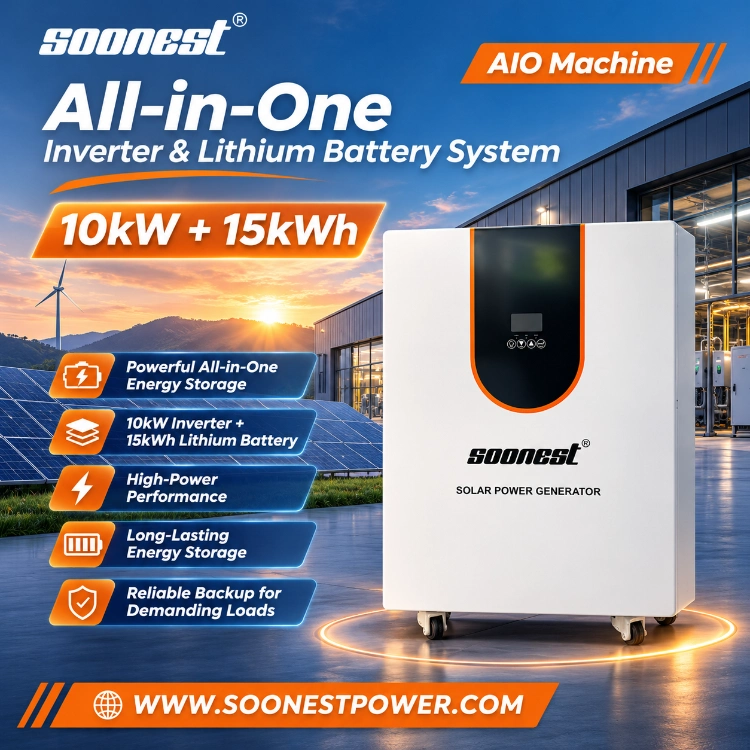
An all-in-one storage unit on the household side with the pump on its own controller, which is usually cheaper than three systems bought at three different times from three different people.
Borehole sizing is its own discipline. Head and flow get checked together. A pump chosen on flow alone fills a tank on paper and never fills it in the field.
What the Pump Should Have

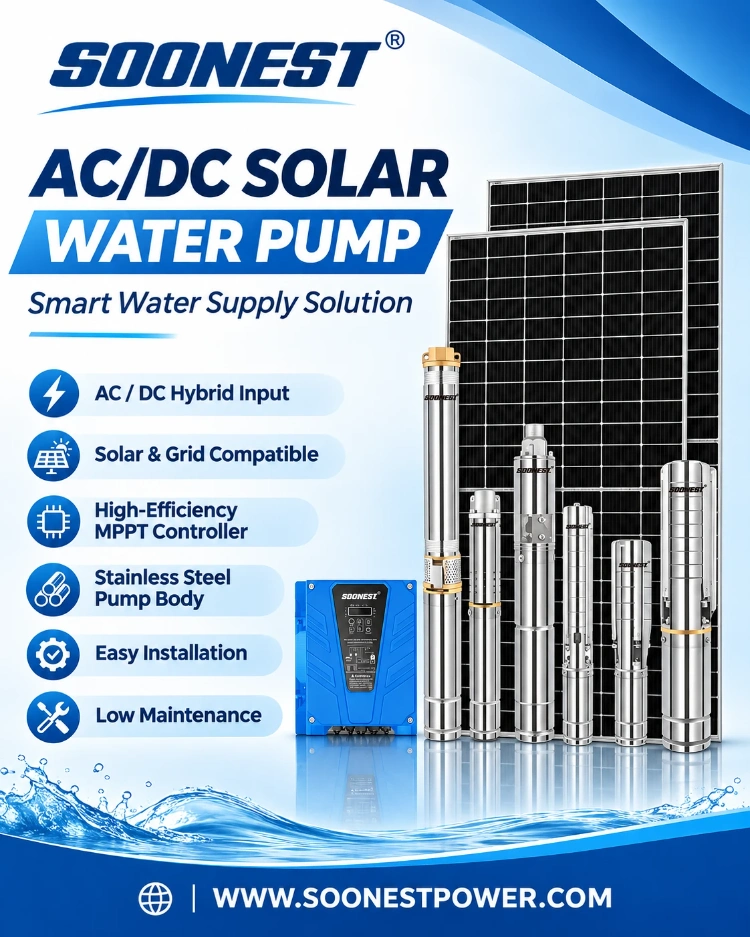
The SOONEST AC/DC solar water pump runs a DC brushless permanent magnet motor. Older motor types give up 15 to 20 percent of that efficiency, and field savings of up to 25 percent in energy use follow from it.
There are no brushes to replace, and the aluminium alloy housing with resin-cast windings carries a high waterproof grade. That grade matters in a borehole that floods every rainy season.
Control is where cheap systems die. MPPT tracking at roughly 85 percent conversion — MPPT holds the array at its most productive voltage — plus reverse connection, overload, low voltage, high temperature, dry run and speed control.
Dry run protection has saved more pumps than every warranty ever written.
Panels wire to the pump directly, no battery anywhere in between. Sky closes in for a fortnight? The AC/DC version falls back on mains or generator.
Four Numbers Before You Sign
| Number | What to bring the supplier |
| Peak-season litres per day | Demand in the weeks the crop actually needs water, not the annual average |
| Total head | Lift from static water level to the highest outlet, plus pipe friction |
| Worst-month peak sun hours | The full-sun equivalent of a day at that exact site, in its meanest month |
| Tank volume for one cloudy day | The cheapest storage in the system and the first line item cut |
A supplier who asks all four is worth shortlisting. A supplier who quotes on motor wattage alone is selling you a number.
The Bottom Line
Fuel is a tax on every litre of water a farm moves. Solar removes the tax and puts the money back into seed, labour and equipment that earns something.
Payback lands in the second or third season, and after that the water comes from free sunshine.
Zhejiang SOONEST New Energy Co., Ltd. brings two decades in photovoltaics to its panels, pumps, inverters and lithium storage, backed by a 4,000 m² production base in Foshan, more than 50 R&D patents, and CE, RoHS, UL, SONCAP and ISO certification across the range. OEM and ODM programmes are standard for distributors.
Send daily water demand, head and site conditions. The technical team works out an array and pump combination before anything ships. The pump range starts here.
FAQ
How long does a solar pump last?
Panels usually come with a 20-year performance warranty. Two or three diesel engines would come and go on the same duty before a well-sealed brushless pump does.
There is no fuel system, no combustion and no brushes, and the controller fails first, which is why a spare on the shelf is money well spent.
Will it pump on a cloudy day?
At reduced flow, yes. MPPT keeps working in weak light and the pump slows rather than stopping. A tank bridges the gap. Batteries rarely pay for themselves at irrigation volumes.
Can the diesel pump stay as backup?
Plenty of farms do that. An AC/DC pump makes it easy by accepting generator input on the same controller. Run the diesel in a bad week only and it lasts years longer.
What array size for a 3 kW pump?
Roughly 3.5 to 4.5 kWp. Head, flow and worst-month sun hours set where it lands. Under-size it and the pump runs below its rated point all season, which is the most common mistake in farm solar.