For shops and small offices, solar air conditioning is most useful when cooling demand overlaps with daylight. The right configuration depends on grid access and how long cooling must continue after sunset.
This guide compares hybrid and pure DC options, then explains how to estimate daytime energy use, panel capacity and any evening storage.
A shop loads differently from a house. It fills when the sun clears the roof and empties when the shutters come down.
Two ways to buy the cooling. Where the street has power, an AC/DC hybrid unit runs off the panels through daylight and lets the grid take the grey hours; no battery is needed for that duty. Where there is no street supply, a pure DC unit runs off the array and a small bank.
Two Peaks, Same Hours
Cooling peaks between noon and four. Panels peak in the same window, which is the break that lets a shop run without a big bank.
Storage then covers the shoulders, the hour before noon and the evening. Most quotes buy capacity for the middle of the day, when the array is already carrying the load.
No inverter on the DC side. Panels and battery go straight to the compressor at 42 to 60 V DC. Brushless motor, so it ramps up instead of switching hard.
Each conversion removed is a loss not paid. At 3.5 kW over eight hours, hundreds of kilowatt-hours a year never turn into heat.
Three Ways, Three Bills
Keep the split, put a hybrid inverter and a battery behind it. The inverter makes the AC the split wants, watches the bank, picks the source.
Size that inverter on surge. A 12,000 BTU split pulls several times its running current for a second or two at start. Surge, not cooling capacity, sets the number.
Both feeds enter one casing on an AC/DC hybrid solar air conditioner. Solar DC and grid AC meet at the same terminals. Panel side first, grid closes the gap. A grey week still trades.
Pure DC is the third route. 24 or 48 V, no AC connection anywhere. Island shops, market stalls, sites where the grid is a rumour.
| Route | Hardware it needs | Where it fits |
| Existing split plus hybrid inverter and battery | Inverter sized on the compressor’s starting surge, plus a bank | Grid present, technician nearby |
| AC/DC hybrid solar air conditioner | Panels plus a grid or generator connection, no battery | Daytime trading on an unreliable grid |
| Pure DC unit, 24 or 48 V | Panels and a small bank, no AC wiring at all | Island shops, market stalls, no grid |
One limit on the middle route. A stable grid and a low daytime tariff can leave the saved units paying for the extra box for years, and a split plus a modest array stays cheaper. Count outage hours per month first.
A 25 m² Shop, By the Numbers
Glass front. Door opening forty times an hour at the peak. Four staff, a queue, a street outside at 38 degrees.
That comes to 12,000 BTU in most hot climates, the rating on the carton. Glass facing west with sun on it after three, and it is 18,000.
The label is not what sizes the system. Running current is. Full output draws 1.1 to 1.3 kW, and duty through the afternoon runs 60 to 70 percent.
Eight trading hours: 6 to 8 kWh. The hottest fortnight pushes the top of that band.
Array next. 8 ÷ (5 × 0.75) gives 2.1 kWp, four 550 W modules on a frame above the roof, six if the door never closes. Two months of generator diesel costs more than the panels.
Storage Only After Sunset
Close at seven and skip the battery. Spend it on shade and insulation, which keep returning long after the array is paid for.
Trade until nine and the numbers change. Three or four hours of evening cooling needs 5 to 7 kWh of 48 V lithium, and that is usually the difference between closing early and not.
DC units have an overnight mode. The control logic throttles the compressor instead of switching it on and off every four minutes.
Inside the Unit
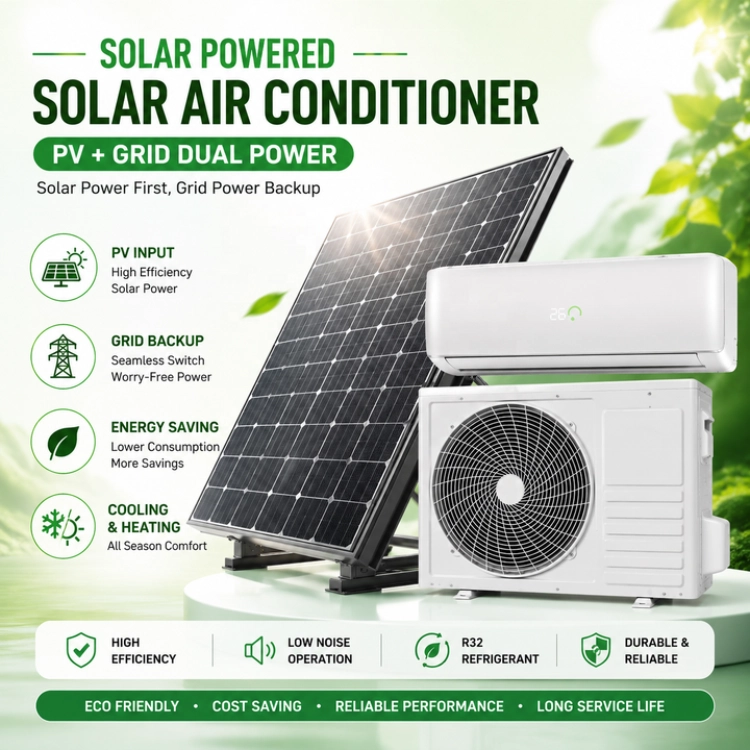
48 V DC from the roof and 110/220 V AC from the street both land on the SOONEST AC/DC solar air conditioner, and the panel side gets first claim on every watt.
Pure DC operation, no inverter losses, BLDC compressor with soft start, -10°C to 55°C ambient rating.
SEER on the label is the seasonal efficiency ratio. A higher number means fewer kilowatt-hours for the same cooling.
Bigger room, or ducting already in the ceiling: the vacuum tube AC/DC hybrid model.
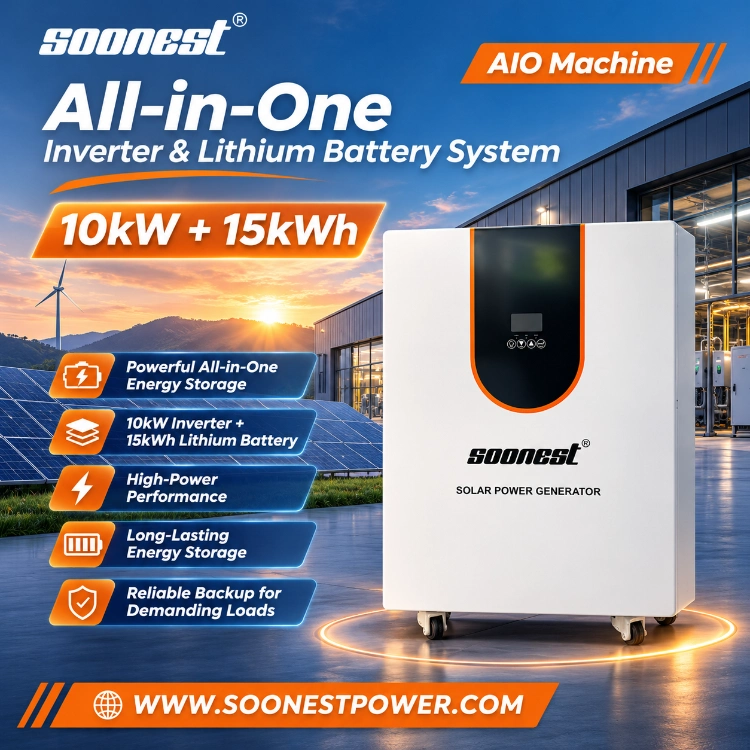
Lights, a drinks fridge, a till. The AIO series puts inverter, MPPT and LiFePO4 in one enclosure. MPPT holds the panels at their best voltage. LiFePO4, the lithium chemistry rated for thousands of cycles.
One bank for the air conditioner, the cold cabinet and the lights. Three systems that cannot talk to each other are three problems.
Dust, Filters, 45 Degrees
Rated to 55°C, but a tin alcove still cooks it by noon. Condenser in shade. A metre of clear air around it. Away from walls that heat up.
In a dusty town the filter comes out weekly. A blocked filter cuts airflow, capacity follows it down, and the compressor runs longer for the same cooling.
Panels hold the same dust. An hour a month with a soft brush beats any setting on the remote.
The Bottom Line
Shops lose customers to heat long before they lose them to price.
Cooling that runs on the same sunshine making the afternoon unbearable is the neatest fix going. No generator humming behind the wall.
Zhejiang SOONEST New Energy Co., Ltd. has spent twenty years on panels, inverters, lithium storage and solar air conditioning. A 4,000 m² production base in Foshan, more than 50 R&D patents, CE, RoHS, UL, SONCAP and ISO certification across the range. OEM and ODM work is routine for distributors who need their own badge.
Send floor area, trading hours and grid conditions. The team returns a unit and array recommendation. The cooling line sits under solar air conditioners.
FAQ
Can a solar air conditioner run all night?
Only with storage behind it. Overnight, a 3.5 kW unit in a well-insulated room draws roughly 4 to 6 kWh. A 48 V bank of 5 to 7 kWh leaves margin.
Are batteries needed for daytime cooling?
No. Wire a DC unit to the array and it runs while the panels produce, which is exactly when the shop is hottest. Storage matters for evening trade and cloudy afternoons.
How many panels for a 1.5 HP unit?
Daytime only, good sun: three to five 550 W modules. West-facing glass or late trading hours push that up.
Will it work with an existing split unit?
Not directly. A standard split wants AC input, so it goes behind a hybrid inverter and a battery. DC and AC/DC units replace the split instead, and usually cost less than a split plus a right-sized inverter.