A practical sizing method that connects 15-minute demand data, PV output, export limits, battery dispatch, string design, and commissioning evidence – instead of choosing an inverter from nameplate power alone.
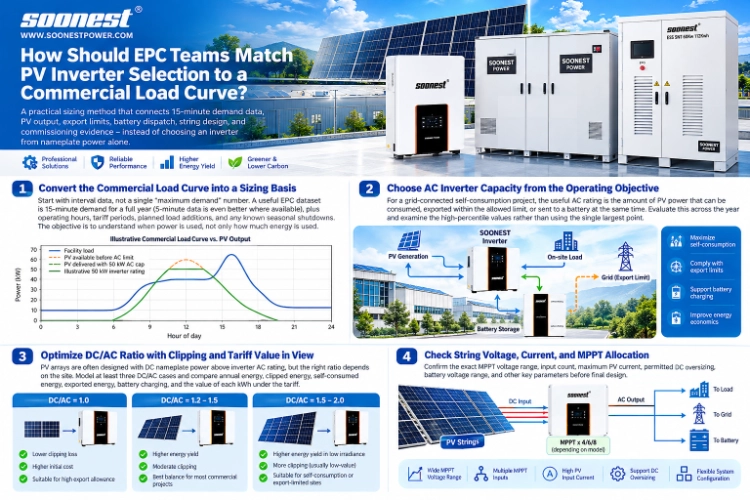
Convert the Commercial Load Curve into a Sizing Basis
Start with interval data, not a single “maximum demand” number. A useful EPC dataset is 15-minute demand for a full year (5-minute data is even better where available), plus operating hours, tariff periods, planned load additions, and any known seasonal shutdowns. The objective is to understand when power is used, not only how much energy is used.
From that dataset, extract four curves: a typical weekday, a typical weekend, the highest-demand day, and the lowest-daytime-load day. Mark the daytime baseload, the 95th/99th percentile demand, the absolute peak, the duration of each peak, and the evening or early-morning loads that cannot be served by PV without storage.
| Load-curve pattern | What it means | Selection focus |
| Midday load is high and stable | PV can be absorbed on site; prioritize PV/load overlap and part-load efficiency. | AC rating, DC/AC ratio, export limit |
| Midday load is low but roof area is large | Export or clipping may dominate; a larger DC array does not automatically justify a larger inverter. | Export cap, annual clipping, curtailment strategy |
| Peak demand occurs after solar hours | A larger PV inverter alone will not reduce the late peak; storage or load shifting is needed. | Battery kW/kWh, dispatch window |
| Short motor or compressor spikes | Do not confuse short starting kVA with continuous energy demand. | Backup surge, islanded load plan |
| Weekend load collapses | Weekday self-consumption may look good while weekend export becomes the binding condition. | Weekend export control, curtailment |
Choose AC Inverter Capacity from the Operating Objective
For a grid-connected self-consumption project, the useful AC rating is the amount of PV power that can be consumed, exported within the allowed limit, or sent to a battery at the same time. A simple screening envelope is: Useful PV AC power at time t ≈ on-site load(t) + permitted export(t) + available battery charging power(t). Evaluate this across the year and examine the high-percentile values rather than using the single largest point.
This framing prevents two common mistakes. First, sizing the inverter to the building’s absolute peak even when that peak happens at 7 p.m. Second, maximizing inverter AC power on a site where the midday load and export limit are both modest. In both cases, the additional nameplate may add cost without adding much usable energy.
Also distinguish kW from kVA. If the inverter is expected to provide reactive-power support, operate at a non-unity power factor, or support certain grid functions, confirm the kVA limit and any active-power derating. For three-phase sites, verify voltage, phase configuration, allowable unbalance, protection coordination, and the local grid-code settings that apply to the point of connection.
Optimize DC/AC Ratio with Clipping and Tariff Value in View
PV arrays are often designed with DC nameplate power above inverter AC rating, but the right ratio depends on the site. East/west roofs, heat, shading, soiling, and frequent low irradiance may support a higher DC/AC ratio because all strings rarely reach nameplate simultaneously. A south-facing array with strong midday irradiance and a tight export limit may show a different optimum.
Model at least three DC/AC cases. Compare annual energy, clipped energy, self-consumed energy, exported energy, battery charging, and the value of each kWh under the tariff. A project that loses 1% of annual generation to clipping can still outperform a larger inverter if that larger inverter mainly produces low-value or prohibited exports; conversely, a production facility with a high midday load may benefit from more AC headroom.
Do not evaluate clipping in isolation. Track when clipping occurs. Five percent clipping concentrated on low-value weekend exports has a different commercial impact from clipping during a high-tariff weekday production window.
Check String Voltage, Current, and MPPT Allocation Before Locking the Model
A load-curve match can still fail if the PV string design sits outside the inverter’s electrical window. For each module and string length, verify maximum open-circuit voltage at the site’s minimum design temperature, minimum operating voltage at the hottest expected cell temperature, maximum input current, short-circuit current margin, and the allowed number of strings per MPPT/input.
Keep electrically different sub-arrays on separate MPPTs where practical: different orientations, tilt angles, shading patterns, or module types should not be combined simply to make the string count convenient. The goal is to keep each tracker operating around one coherent I-V behavior.
If Storage Is Included, Size Battery Power and Energy Separately
A hybrid inverter creates two separate questions: how much battery power is required, and for how long. Peak shaving usually needs enough kW to hold the grid import below a target during a limited window; backup needs enough kW for the critical loads and enough kWh for the required outage duration. Those are not the same duty cycle.
For a demand target, a useful first-pass battery-power calculation is the positive difference between the load and the desired grid-import limit after PV contribution. Then integrate that difference over the peak window to estimate usable energy. Apply battery state-of-charge limits, round-trip losses, reserve requirements, battery temperature limits, and any inverter charge/discharge constraints in the detailed model.
For backup, create a separate critical-load schedule. Identify loads that must remain energized, loads that can be shed, and loads with high starting current. Do not assume that “50 kW inverter” means every 50 kW combination of motors, compressors, lifts, or HVAC equipment can start in island mode. Confirm surge/overload behavior and transfer architecture with the supplier and the project electrical engineer.
Product Example: A 50 kW Three-Phase Hybrid Inverter for a Commercial Site
For a medium commercial or light-industrial project, a relevant Soonest option is the 50 kW configuration of the SOONEST 10-50 kW IP65 Three-Phase 380V High-Voltage Hybrid Solar Inverter. The official page positions this family for commercial and industrial energy systems and lists 10, 12, 15, 20, 30, 40, and 50 kW ratings.
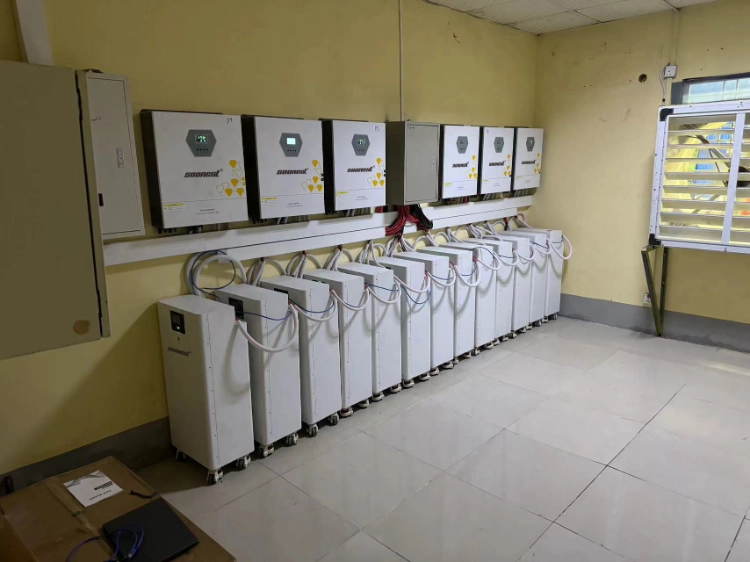
Why it fits this article’s topic: the published page identifies three-phase 380V output, high-voltage battery compatibility, MPPT control, peak-shaving and time-of-use modes, IP65 enclosure, and monitoring/communication options. Those functions map directly to the questions raised by a commercial load curve: how PV serves daytime demand, how storage shifts energy, and how the system behaves when grid import is intentionally capped.
What still needs to be confirmed before design release: the exact 50 kW model’s MPPT voltage range, MPPT/input count, maximum PV current, permitted DC oversizing, battery voltage range, battery BMS protocol, charge/discharge power, backup/overload capability, parallel support, grid-code certification, protection functions, and communication hardware. The product page explicitly notes that several of these details vary by model or configuration.
| Selection item | Published family information | EPC verification before PO |
| Commercial power class | 50 kW variant is listed | Match to the interval load and export/charging envelope |
| AC system | Three-phase 380V family | Confirm site voltage/frequency and interconnection requirements |
| Battery | High-voltage battery compatible | Confirm exact voltage range, BMS protocol and power limits |
| Peak management | Peak shaving / time-of-use modes are described | Confirm dispatch logic, metering location and control response |
| PV inputs | MPPT control is described | Confirm exact MPPT count, voltage/current limits and string allocation |
| Parallel expansion | Available on selected models | Confirm 50 kW model, firmware and architecture before relying on it |
Worked Example: How the Load Curve Changes the Decision
Assume a commercial facility has a 32-42 kW daytime load, a 68 kW demand spike around 16:30, a 10 kW night baseload, and a 5 kW export limit. A PV model shows roughly 55-56 kW of available power around solar noon on clear days. The project also wants to reduce the late-afternoon grid peak and keep 25 kW of critical loads available during outages.
- Self-consumption check: around noon, a 50 kW inverter can serve a 40 kW building load and still have up to roughly 10 kW of headroom for battery charging or export, subject to the actual control limits. A larger inverter may add little value unless the battery can absorb more power or export is permitted.
- Clipping check: if the array is, for example, 60 kWp DC, the nominal DC/AC ratio is 1.20. The EPC should simulate how often the 50 kW AC ceiling is reached and whether the clipped energy would have been high-value self-consumption, battery charging, or low-value export.
- Peak-shaving check: the 16:30 load spike occurs when PV is falling. If the grid target is 50 kW and PV contributes 8 kW at that time, the battery must cover approximately 10 kW (68 – 50 – 8) for the duration of the peak, plus losses and control margin.
- Backup check: the 25 kW critical-load requirement should be tested independently of the grid-connected peak. Confirm continuous islanded output, surge capability, battery discharge limit, transfer behavior, and the actual list of critical circuits.
This example is why “the building peak is 68 kW, so buy a 68 kW inverter” is weak logic. The 68 kW event is relevant to battery dispatch and backup architecture, while the PV inverter’s grid-connected AC rating is driven by the simultaneous PV/load/export/charging envelope.
Put the Sizing Assumptions into the Purchase Order and Commissioning Plan
A defensible EPC selection ends with verifiable documents and tests. Include the following items in the technical schedule so the supplier, EPC, and commissioning team are checking the same design basis:
- Exact inverter model and firmware/configuration; AC kW and kVA limits; grid voltage/frequency; required grid-code profile and certificates.
- PV array schedule by MPPT: module model, modules per string, strings per input, cold Voc, hot Vmp, design current and DC isolation/protection.
- Battery interface: nominal/operating voltage, BMS protocol, maximum charge/discharge power, usable energy, SOC reserve and backup requirements.
- Export-control method and meter/CT location; zero-export or export-limit acceptance test; response to communication loss.
- Peak-shaving target and tariff window; expected battery dispatch; recovery behavior after the peak period.
- Commissioning evidence: irradiance/array condition, DC voltage/current by MPPT, AC kW/kVA/PF, grid voltage/frequency, battery SOC/power, alarms, communications, and recorded pass/fail results.
Commission both the normal case and the edge case. At minimum, test start-up, high-PV/low-load export limiting, battery charge/discharge commands, communication loss, grid outage (if backup is in scope), restart, and the most demanding critical-load condition. Keep the resulting configuration file, settings screenshots, test sheets, and one-line diagram with the handover package.
For the Soonest product example used here, review the official 10-50 kW three-phase high-voltage hybrid inverter page and request the exact 50 kW technical data before final design approval.
FAQ
Should inverter power equal the building peak demand?
Not necessarily. Compare the inverter with the simultaneous PV/load/export/battery envelope. A peak that occurs after sunset may matter more to battery or grid capacity than to PV inverter AC rating.
What load data is most useful?At least 12 months of 15-minute interval demand where available, plus tariff periods and planned load changes. Monthly kWh is insufficient for peak-shaving and export-control decisions.
Is a higher DC/AC ratio always better?
No. It can improve inverter utilization in some climates and orientations, but the value depends on clipping, tariff value, export limits, thermal/environmental conditions, and the actual PV profile.
What should be checked first for PV strings?
Cold-weather Voc against maximum DC voltage, hot-weather Vmp against the MPPT operating range, input-current limits, and the allocation of different roof orientations or shading patterns across MPPTs.
Why separate peak shaving from backup?
Peak shaving is usually a grid-connected energy-management duty. Backup is an islanded power-quality and critical-load duty with separate kW, kWh, surge, transfer, and protection requirements.