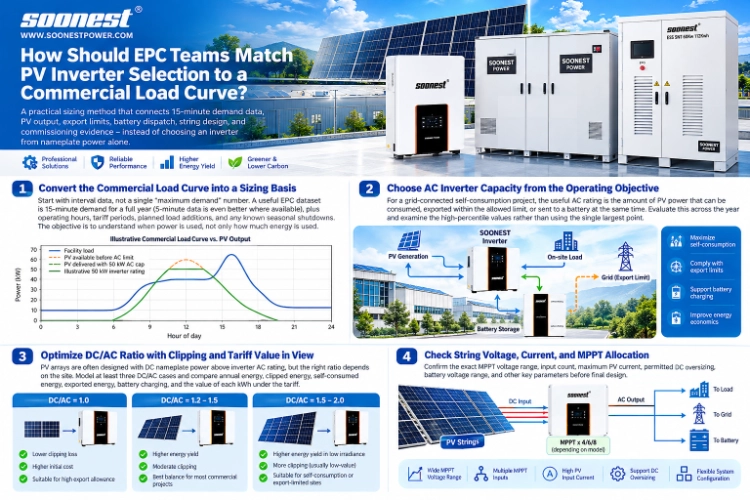
Solar PV string sizing on a multi-direction roof should start with electrical behavior, not panel count. Modules that face different azimuths receive different irradiance profiles, so placing them on one MPPT can pull the stronger roof section away from its useful operating point. The practical answer is to separate roof planes by MPPT whenever the inverter allows it, then check cold-weather open-circuit voltage, hot-weather operating voltage, and current limits before finalizing the series count.

Key Takeaways
Treat each roof orientation as a separate generation profile; east and west strings rarely reach their maximum power at the same time.
Use the inverter MPPT voltage window and maximum PV current as hard limits, then size the string against both the coldest and hottest expected module conditions.
A high-power module such as the SOONEST 550W–720W photovoltaic solar panel still needs electrical matching; wattage alone does not determine a safe series count.

Why Roof Direction Changes String Behavior
Roof orientation changes the time and shape of the irradiance curve. An east-facing plane usually builds output earlier, while a west-facing plane produces more late-afternoon energy. In a series string, the operating current is shared by every module, so a shaded or poorly illuminated module limits the current available from the rest of the string. When two roof planes are placed on the same tracker, the inverter sees a compromise operating point rather than two independent maxima.
Voltage, Current, and the MPPT Window
The series count is controlled by voltage, while parallel string count is controlled mainly by current. The design must satisfy three separate checks: the cold-weather open-circuit voltage must stay below the inverter maximum DC voltage; the hot-weather operating voltage must remain inside the MPPT window; and the combined short-circuit or operating current must remain within the input limit. These checks are different and should not be replaced by a single nominal-voltage calculation.
For a module with a 40 V operating voltage, a preliminary 10-module string would be about 400 V at its nominal operating point. That figure is only a design starting point. Module voltage rises in cold conditions and falls as the cell temperature increases, so the final calculation needs the module datasheet temperature coefficient and the site design temperatures. The same discipline applies to current: two parallel strings can double the input current even though their voltage remains close to one string.
Keep Parallel Strings Electrically Comparable
Parallel strings connected to one MPPT should use the same module model, series count, orientation, and a similar shading profile. Their voltages must be close enough to operate at one tracker voltage. If one branch has fewer modules, its preferred operating voltage will differ; the tracker cannot independently hold both branches at their own maximum power points. The weaker branch may also receive reverse current under abnormal conditions, which is why string protection and the module reverse-current rating must be reviewed rather than assumed.
Commissioning should capture each string’s open-circuit voltage and operating current under comparable irradiance. A large difference is a reason to check polarity, connector crimping, shading, module count, or a damaged bypass-diode path. The comparison is more useful when the irradiance and module temperature are recorded, because two measurements taken under different cloud conditions cannot establish whether the strings are actually mismatched.
A Practical Layout for East West and South Roofs
The cleanest layout assigns each roof plane to its own MPPT, provided the inverter has enough independent trackers and the voltage range is compatible. If a single tracker must serve more than one plane, keep the strings electrically identical and accept that the mismatch will reduce harvest during part of the day. Do not mix different module types, unequal series counts, or heavily shaded and unshaded sections on the same tracker simply to fill unused roof area.
| Roof condition | Preferred electrical arrangement | Main check |
| Same azimuth, similar tilt | Parallel strings on one MPPT when current permits | Combined operating current and fuse rating |
| East and west planes | Separate MPPTs or separate inverter inputs | Different daily power curves and tracker independence |
| Partial shading on one plane | Separate the affected area if possible | Bypass-diode behavior and shade duration |
| Short roof plane with too few modules | Confirm minimum MPPT voltage before use | Hot-weather operating voltage |
The MPPT solar controller sizing guidance is also useful when the array feeds a battery-based system, because PV voltage and charging current must be checked together rather than treated as independent labels.
Two Field Checks That Prevent Expensive Rework
Check 1: Cold Voltage at the Disconnect
Measure or calculate the maximum open-circuit voltage at the lowest design temperature, including the full series count. A string that is acceptable at 25°C can exceed the inverter limit on a clear, cold morning. Record the module Voc, temperature coefficient, calculated cold voltage, and inverter maximum DC voltage in the commissioning file.
Check 2: Cable Routing Between Roof Planes
Different roof sections often create unequal cable routes. Long positive and negative runs can increase voltage drop and complicate polarity checks, while parallel strings routed through different paths can make current sharing less predictable. Keep polarity labels at both ends, use consistent conductor sizes, and verify each string independently before combining inputs.
Where the Simple Separate MPPT Rule Is Not Enough
Separate trackers do not solve every mismatch. If a roof plane cannot provide the inverter minimum voltage during hot conditions, assigning it to a separate MPPT will still leave the input outside its useful range. Likewise, a string may fit the voltage window but exceed the tracker current when additional parallel strings are added. In these cases, the options are a different string length, a different inverter input arrangement, or a design revision that removes the weak roof section from the array.
For system integrators and installers, Soonest provides PV modules, hybrid inverters, batteries, and related system support. The useful sourcing question is not simply whether a module is available; it is whether the selected module, inverter MPPT window, monitoring method, and site temperature assumptions can be supplied as one coherent electrical schedule. Technical details can be confirmed through the service and support channel before the bill of materials is released.
FAQ
Can east and west solar panels share one MPPT
They can be electrically connected in some designs, but the arrangement is usually less effective than giving each orientation an independent tracker. The two planes have different irradiance curves, so one tracker must compromise between them. Use one MPPT per orientation when the inverter architecture and voltage limits allow it.
How many solar panels should be in one string
There is no safe universal count. Calculate the series voltage at the coldest condition, verify it is below the inverter maximum, and check that the hot operating voltage stays above the MPPT minimum. Then check current for any parallel strings.
Does a higher wattage panel always reduce the number of strings
Not automatically. Higher wattage can change operating current and voltage, and the module dimensions may alter the available roof layout. String count must be based on the electrical values and roof geometry, not the wattage label alone.
Conclusion
Reliable multi-direction PV design comes from matching roof behavior to MPPT behavior. Separate orientations where possible, validate voltage at temperature extremes, check current after parallel connections, and record the result as an installation schedule. That process produces a system that is easier to commission and easier to explain when measured output differs between roof sections.