A 100 kW 215 kWh C&I energy storage system should be planned from the factory’s measured load profile, outage behavior, and generator limits, not from the cabinet rating alone. The 100 kW figure is maximum charge or discharge power; 215 kWh is nominal stored energy. Their ratio suggests about 2.15 hours at full power before reserve limits and conversion losses. In practice, the system may be more valuable when it clips short demand peaks, carries a defined critical-load bus, and delays generator starts. Agree on the operating job first, then verify usable energy, switchgear, controls, safety provisions, and acceptance criteria.
Key Takeaways
- Use interval meter data and generator logs to define the battery’s job before requesting a quotation.
- Size peak shaving in kW and duration in kWh; do not treat the two ratings as interchangeable.
- Separate essential outage loads from the full factory load so the battery is not consumed by noncritical equipment.
- Write the grid, battery, PV, and generator priority sequence into the EMS functional specification.
- Accept the system against measured operating scenarios, not only a cabinet power-on test.
Start with the Factory Load, Not the Cabinet
Collect several representative weeks of factory demand at the shortest available meter interval. Include normal production, shift changes, compressor starts, large motors, HVAC, weekends, utility tariffs, outages, and generator fuel and runtime records.
Peak shaving only works when the battery can recognize and cover the part of the load that crosses a target. Suppose a site reaches 420 kW for 45 minutes and wants to hold grid demand near 340 kW. The discharge target is 80 kW, and the AC-side energy for that event is 60 kWh. The battery-side requirement will be higher after PCS losses, auxiliary consumption, state-of-charge reserve, aging allowance, and the supplier’s usable-energy limit are applied.
Repeat the calculation for each recurring peak and check whether peaks overlap with outages. A system that handles one 45-minute event may not recover before a second event in the same shift.
Separate kW, kWh, and Usable Energy
The 100 kW power rating limits how much demand the PCS can offset at one moment. A 160 kW load step cannot be fully covered by a 100 kW PCS, even if the battery has ample energy. The 215 kWh energy rating describes nominal storage, but the energy available to the load depends on the permitted state-of-charge window, temperature, conversion efficiency, degradation policy, and any reserve held for backup.
One bidder may quote nominal energy, another usable DC energy, and a third AC energy at the connection point. Require every value to identify its measurement boundary and operating conditions. The related Soonest guide to a 100 kW / 241 kWh commercial ESS cabinet explains why buyers should check usable capacity rather than assume the nameplate equals delivered energy.
Define Peak Shaving and Backup as Different Jobs
Set a Demand Limit the EMS Can Enforce
For peak shaving, the EMS needs grid-import measurement, a discharge threshold, state-of-charge limits, and a recharge rule. An unrealistically low target can empty the battery early, while a high target may leave savings unrealized.
Identify whether the utility uses a 15-minute, 30-minute, or other demand window. A discharge that stops too early may reduce an instantaneous spike without reducing billed demand.
Build a Critical-Load Bus for Outages
During an outage, supply a pre-agreed critical-load panel unless the full plant has been proven within power and energy limits. Candidates include controls, safety lighting, selected production equipment, and orderly shutdown loads. Treat large heaters, chillers, and compressors separately.
List each critical load’s running kW, starting demand, runtime, and restart sequence. Confirm the PCS overload curve and protection coordination; motor starting and transformer inrush can exceed steady-state demand.
Coordinate the Battery with the Diesel Generator
Battery storage can reduce generator runtime, but a reliable hybrid sequence needs more than an automatic transfer switch. Define when the battery forms or supports the site bus, what state of charge triggers a generator start, how long the generator must run before accepting load, and whether it may charge the battery while serving the factory.
A practical sequence may reserve energy for short outages and start the generator only when the outage persists or state of charge reaches a floor. Obtain minimum loading, warm-up, cool-down, and charge limits from the generator and PCS suppliers. Poor coordination can cause repeated starts, reverse-power alarms, or unstable frequency.
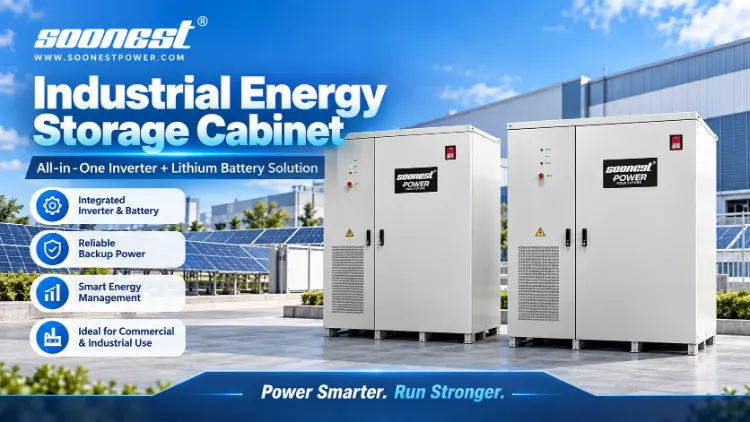
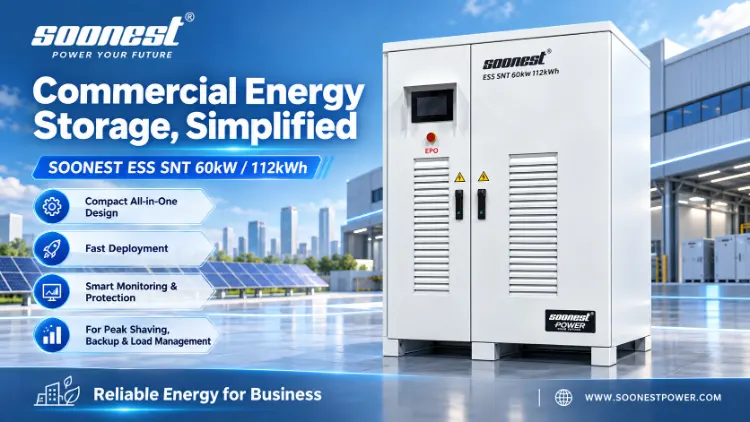
When reviewing the Soonest product portfolio, ask for a project-specific single-line diagram and control narrative for the proposed C&I ESS. The cabinet shown here is relevant to factories that need a defined 100 kW power block and approximately two hours of nominal energy, but the final fit depends on usable-energy documentation, grid code, switchgear, thermal management, and the load study rather than the rating alone.
Write the Electrical and Control Scope Before Ordering
Define the point of connection, voltage, frequency, earthing, fault level, transformer capacity, CT location, protection interfaces, and whether PV, grid, generator, and battery share an AC bus. Assign responsibility for breakers, metering, cabling, communications, civil works, ventilation, fire detection, and emergency shutdown.
Request a complete signal list for the BMS, PCS, EMS, utility meter, PV inverter, generator controller, and site system. State the response to communications failure. Define remote access, user roles, alarm history, and data export before commissioning.
The Soonest service support page describes design, inspection, troubleshooting, and maintenance support. For a C&I project, convert those broad services into named deliverables: approved drawings, settings files, test reports, operator training, spare-parts list, remote-support method, and response responsibilities.
Check the Site Conditions and Safety Boundary
Confirm ambient temperature, solar exposure, dust, humidity, drainage, flood level, corrosion, access clearance, lifting route, and separation from occupied or high-risk areas. The supplier should state environmental limits and derating.
The fire plan must match local regulation and equipment design. Define detection, alarm routing, ventilation, isolation, emergency response, signage, and trained access. Check requirements with the local authority, insurer, and fire service.
Commission with Real Operating Scenarios
Acceptance should prove meter polarity, charge and discharge, state-of-charge limits, peak-shaving response, loss of grid, generator start request, grid return, communication loss, alarms, emergency stop, and trip recovery. Record power, energy, state of charge, voltage, frequency, and event timestamps.
Run at least one test with representative factory loads. A no-load energization confirms wiring but not control performance. Back up settings, verify alarm retrieval, and prove safe isolation. Use Soonest’s solution and case library as a starting point, then require evidence specific to the proposed site.
Build the Business Case from Measured Avoided Cost
The financial model should separate demand-charge savings, time-of-use shifting, reduced diesel fuel and maintenance, avoided production interruption, and any value from PV self-consumption. Each benefit needs its own operating assumption so two benefits are not counted for the same stored kilowatt-hour.
Test lower peaks, more frequent outages, seasonal production, reserve, degradation, auxiliary consumption, and fuel-price changes. A robust quotation connects equipment, controls, warranty conditions, and service scope to a load profile the buyer can verify.
Conclusion
A 100 kW / 215 kWh C&I energy storage system can support peak shaving, critical-load backup, and diesel coordination, but those functions compete for the same power and energy. Begin with measured factory data, assign reserve explicitly, specify the operating sequence, and test the final system against the events that matter on site. Soonest can then review the load profile, single-line diagram, tariff, outage record, and generator data against an appropriate system configuration rather than relying on a nameplate-only selection.
FAQ
How long can a 100 kW / 215 kWh battery run at full output?
The simple nameplate ratio is 2.15 hours, but that is not a guaranteed AC runtime. Usable state-of-charge limits, PCS losses, auxiliary loads, temperature, aging policy, and backup reserve reduce the energy available to the factory. Use the supplier’s guaranteed usable AC energy for the final runtime calculation.
Can a 100 kW ESS replace a factory’s diesel generator?
Only if the critical load, starting demand, outage duration, and required reserve all fit within the PCS and usable-energy limits. Many factories obtain a better result by using the battery for short outages and controlled transitions while retaining the generator for longer events.
What data should a factory send with an ESS quotation request?
Send interval load data, utility tariffs, single-line diagrams, voltage and frequency, transformer and generator details, outage records, critical-load priorities, site conditions, available space, PV information, and the required peak-shaving and backup scenarios.