Solar water pump sizing begins with daily water volume and total dynamic head. Borehole depth alone is not enough. Include the pumping water level, elevation to the tank or field, pipe friction, and outlet pressure. Once the duty point is known, select a pump whose curve reaches that flow and head, then match the controller and PV array to its voltage, current, and seasonal solar conditions. A storage tank usually buffers energy more simply than batteries, while an AC/DC pump can retain backup when water demand cannot wait for sunshine.
Key Takeaways
- Calculate the design-day water demand before choosing pump power or panel count.
- Use pumping water level, not only borehole depth, when calculating total dynamic head.
- Select from a pump curve at the required flow and head; maximum-flow and maximum-head labels do not occur at the same duty point.
- Check the controller’s PV voltage and current window at both hot and cold module temperatures.
- Prefer daytime pumping into a tank; add AC backup only when the water-service requirement justifies it.
Define the Design-Day Water Requirement
Start by separating irrigation, livestock, washdown, and household water. Irrigation demand should be based on the cropped area, irrigation method, soil, climate, and the agronomist’s design-day requirement. Livestock demand should include the number and type of animals, drinking water, trough losses, and cleaning. Do not size from an annual average if the dry season drives the project.
Convert the result into cubic metres per day and reliable pumping hours in the design season. If a farm requires 36 m³ per day over six effective hours, required average flow is 6 m³/h. Add an allowance for cloudy periods, maintenance, and restricted irrigation windows using site data rather than an unexplained percentage.
A tank decouples water use from solar production: pump during sunlight and draw water later. Size it for the required continuity and protect it against overflow and contamination.
Calculate Total Dynamic Head Correctly
Total dynamic head includes the pumping water level below ground, elevation to the delivery point, friction in the rising main and distribution pipe, and pressure required at the outlet or irrigation equipment.
Use Pumping Water Level, Not Static Level
The static water level is measured when the well is at rest. Once pumping begins, the level may fall because of drawdown. The pump must work against the pumping water level, so a design based only on the static level can underestimate head and leave the system short of water. Obtain a borehole yield or pumping test and state the expected drawdown at the proposed flow.
Keep the pump submerged under the lowest expected water level within the manufacturer’s depth and cooling limits. Provide dry-run protection or a correctly placed level sensor.
Add Pipe Friction and Delivery Pressure
Record pipe material, internal diameter, length, bends, valves, filters, and check valves. Calculate friction at the design flow; long, narrow, or heavily fitted pipework increases loss quickly.
Convert any field-inlet pressure required by drip lines or sprinklers into head and add it to the total. Otherwise, water may reach the field but lack pressure at the emitters.
Match the Duty Point to a Pump Curve
A pump curve shows the flow available at different heads. Locate the required total dynamic head and read the flow from the candidate curve. Reject a model that meets the daily flow only at a much lower head. The advertised maximum flow is generally measured near low head, while maximum head occurs near little or no flow; neither label alone defines a working system.
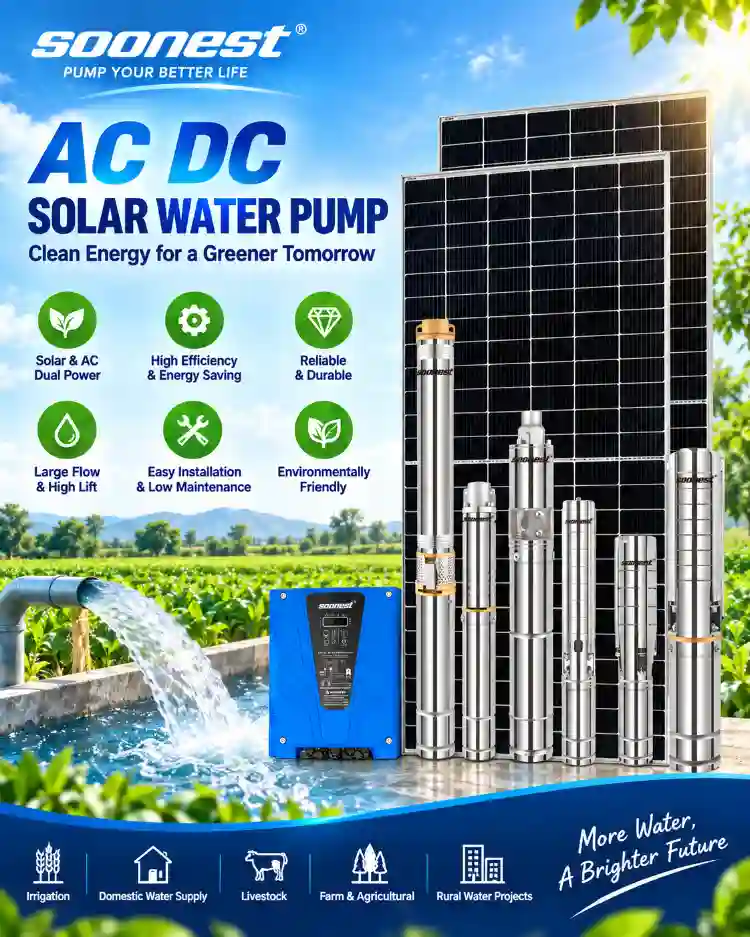
The official Soonest AC/DC solar water pump range includes battery-free solar operation, MPPT control, and selected models with AC backup. The page lists options up to 320 metres maximum head and 700 m³/h maximum flow, but it also instructs buyers to use the corresponding model datasheet for exact flow, head, and power. For a deep-borehole farm, request the curve for the exact model and mark the proposed duty point before approval.
Size the PV Array Around the Controller Window
The PV array must supply the design-day energy and remain inside controller limits. Obtain the MPPT voltage range, maximum open-circuit voltage, input current, recommended array power, start voltage, and wiring arrangement from the pump-controller datasheet.
Check string open-circuit voltage at the lowest expected temperature and operating voltage at the highest cell temperature. An invalid string may fail to start in heat or damage the controller in cold weather. Keep short-circuit and operating current within input limits.
Use monthly solar-resource data for the irrigation season rather than an annual average. Account for dust, module temperature, cable loss, mismatch, shading, and orientation using the supplier’s design method.
Soonest offers a high-power solar panel range, but wattage alone does not establish compatibility. Confirm module Voc, Vmp, Isc, Imp, temperature coefficients, connectors, and quantity against the controller.
Decide Between DC-Only and AC/DC Backup
A direct-solar DC system has fewer conversion stages and can operate without batteries. It is often the cleanest option where a tank can store water and pumping can follow sunlight. The trade-off is variable flow through the day and no pumping after dark unless another power source is available.
An AC/DC controller adds resilience when grid or generator power exists. Define source priority, changeover, acceptable voltage and frequency, generator size, earthing, and protection. Hybrid input does not remove the need to match the pump curve or prevent dry running.
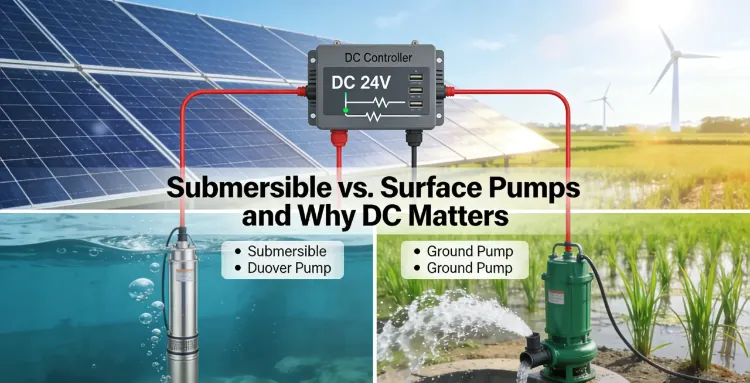
The earlier Soonest comparison of submersible and surface solar pumps is useful when deciding pump type. Deep boreholes normally point toward a submersible pump because it pushes water upward from below the water level; shallow open sources may suit an accessible surface pump.
Design the Pipe, Cable, and Borehole Installation
The rising main must suit operating pressure, water quality, pump weight, and depth. Include a check valve, wellhead support, safe lifting method, and a removal plan. Confirm whether sand, sediment, or corrosive water changes pump material or filtration needs.
Size long motor cables for current, length, installation method, temperature, and permitted voltage drop. Use submerged-service joints, strain relief, earthing, surge and lightning protection, and mechanical protection from livestock and vehicles.
Place isolators and controllers where trained staff can reach them, protected from heat, dust, rain, and unauthorized adjustment. Provide labels, a wiring diagram, and a fault-code guide.
Commission Against Water Output, Not Only Electrical Power
Record static and pumping levels, flow, pressure, tank fill time, PV voltage and current, controller status, and solar conditions. Compare the duty point with the approved curve. Test low-water and tank-full shutdown, restart, AC backup, and alarms.
Repeat the output check after the irrigation network is connected. Filters, valves, and emitters add resistance. Train operators to clean panels, inspect leaks and cables, check water levels, read controller faults, and stop the pump for unusual vibration or declining flow.
The Soonest service support team can be asked for system design and troubleshooting support. Put the required documents into the purchase order: pump curve, controller limits, PV string design, installation drawing, protection settings, commissioning record, maintenance schedule, spare-parts list, and warranty conditions.
Conclusion
Deep-borehole solar pumping succeeds when the hydraulic and electrical designs meet at one verified duty point. Define daily water demand, calculate total dynamic head with drawdown and friction, select the exact pump curve, and then match the PV array to the controller across seasonal conditions. Soonest can review the borehole test, delivery elevation, pipeline, water requirement, solar resource, and backup preference before a model is selected. That information is more useful than requesting a pump by horsepower or borehole depth alone.
FAQ
How many solar panels are needed for a deep-well water pump?
The count depends on pump input power, controller voltage and current limits, module electrical data, local solar conditions, cable loss, and the required daily water volume. Select the pump duty point first, then design the series and parallel PV strings from the exact controller and module datasheets.
Is a battery required for a solar borehole pump?
Usually not. Direct-solar pumping into a water tank often provides simpler storage with fewer losses and less maintenance. A battery may be considered only when night pumping or a specific service requirement cannot be met by water storage or AC backup.
Why does a pump deliver less water than its advertised maximum flow?
Maximum flow is normally quoted at low head. A deep borehole, pipe friction, elevation, filters, valves, and outlet pressure all increase total dynamic head and move the operating point to a lower flow on the pump curve. Verify the actual system head and compare measured output with the exact model curve.