An Off-Grid Solar System can run air conditioners without an oversized battery when daytime cooling is served directly by solar power, the battery is reserved for night or cloudy gaps, and the cooling load is sized from room demand rather than guesswork. SOONEST develops solar cooling and power products for homes, shops, farms, offices, and remote buildings; its company profile is useful when checking production background. The recommended product here is the DC Solar Air Conditioner System, a solar-powered cooling solution with an inverter compressor, energy management, solar panel input, optional battery storage, and optional grid backup. The goal is not the largest battery. It is asking the battery to do the right job.
In hot regions with weak grids, a standard air conditioner can turn a small solar project into an expensive storage project. The compressor starts hard, the afternoon load is high, and the owner adds battery capacity to cover every possible hour. It looks safe on paper. In real use, it often means higher cost, heavier wiring, and a system that still feels underplanned when the weather turns humid.
How Should You Size Cooling Loads Before Buying Panels or Batteries?
Start with the cooling problem, not the battery catalog. Air conditioners are different from lights or phone chargers because they create both a steady running load and a short starting stress. If the load survey is weak, the battery size becomes a guess, and guesses are expensive.
Room Heat Gain and Real Running Hours
List each room or working area that needs cooling. Add room size, roof exposure, wall insulation, number of people, door openings, and real running hours. A farm office used from 10 a.m. to 5 p.m. is a good solar match. A clinic room that must stay cool all night is also a battery problem. That distinction matters more than a neat one-line capacity estimate.
Compressor Start Behavior and Daytime Solar Window
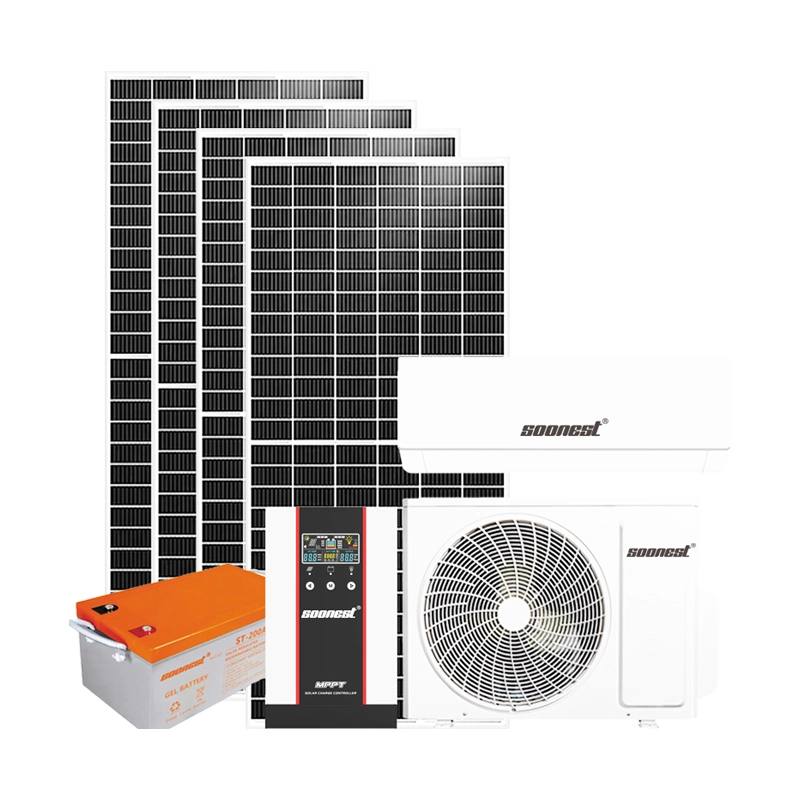
Traditional compressor loads can pull a sharp starting current. An inverter compressor is gentler because it adjusts speed according to room temperature and cooling demand. The DC Solar Air Conditioner System uses this kind of compressor logic, so the design can focus on steady cooling instead of repeated electrical shocks. Even then, the installer should confirm rated input power, starting behavior, controller limits, and cable length before selecting the array and battery.
Loads That Should Stay Outside the Cooling Circuit
Do not quietly add everything to the air-conditioner battery. Lighting, refrigerators, fans, Wi-Fi, pumps, and workshop tools should be listed as separate loads. Some can run in the same daytime solar window; others need their own backup plan. Mixing them all into one estimate makes the battery look wrong either way.
How Can an Off-Grid Solar System Run Air Conditioners Without an Oversized Battery?
The best design reduces battery work before it adds battery capacity. Solar cooling is strongest when the sun and cooling demand arrive together, which is common in homes, shops, schools, guard rooms, clinics, and farm offices. The system should first use that overlap.
Direct DC Cooling During Strong Sun
Solar panels generate DC power. A direct solar cooling layout can send compatible DC power through the controller and power-management equipment to the air-conditioning system. Fewer conversion steps can mean less wasted energy. In a small Off-Grid Solar System, that can be the difference between a battery that handles evening comfort and a battery that carries the whole afternoon for no good reason.
Battery Backup for Night and Cloudy Gaps
Battery backup should be sized from the hours that solar cannot cover. If a room only needs cooling after sunset for two hours, do not size the battery for a full-day load. If a bedroom, clinic, or telecom room needs longer backup, calculate that duration and keep a discharge reserve. Battery voltage and capacity must also match the selected air-conditioner model and controller.
| Design Check | Data or Source | Why It Matters | Action Before Ordering |
| Cooling demand | IEA: AC and fans use about 20% of building electricity and 10% of global electricity. | Cooling can distort battery sizing. | Separate daytime, nighttime, and backup hours. |
| PV field losses | NREL PVWatts: typical system losses are about 14%. | Panel nameplate watts do not equal usable appliance power. | Allow for heat, dust, wiring, mismatch, and shading. |
| Product configuration | Product page: package may include panels, AC units, controller, cables, optional battery, and grid backup. | Battery size depends on package and operating mode. | Confirm components, voltage, backup time, and grid condition. |
Grid or Generator Backup as a Design Safety Net
A backup source does not mean the project failed. In African, Middle Eastern, and Southeast Asian markets, grid power may be unstable and diesel fuel may be costly, but selected backup can still protect comfort and equipment. Hybrid support cuts diesel runtime without pretending every rainy evening will be solved by solar alone.
What Should You Confirm Before Installation?
Installation quality decides whether the design survives real weather, dust, voltage variation, and daily use. A neat quote helps, but a quote without site details is not a design. Before ordering, confirm these points with the supplier or installer.
Solar Array Capacity and Shading Checks
Panel capacity depends on cooling capacity, rated input power, local solar irradiation, running hours, installation angle, shading, and required solar contribution. NREL’s PVWatts tool uses an estimated system loss value of about 14% for typical PV systems, a useful reminder that panel nameplate power is not delivered perfectly at the appliance. Dust, heat, wiring, and shading all take their share.
Controller, Voltage, and Cable Compatibility
The solar panels, controller, air conditioner, battery, and backup equipment must speak the same electrical language. Confirm DC input voltage, battery voltage, cable size, controller rating, grounding, protective devices, and local grid voltage if backup is included. The product page also notes that components should be confirmed before ordering. That is not small print. It is the line between a system package and a pile of parts.
Installation Quality and Maintenance Access
Allow ventilation around the outdoor unit, leave access for cleaning filters, and protect cable runs from sun, rodents, and standing water. Installation should be completed by qualified HVAC and solar technicians. For guesthouses, guard rooms, rural shops, or farm housing, ask for drawings, component lists, installation photos, and commissioning checks. The company’s service support section is a sensible next stop for technical communication before purchase.
Conclusion
A well-sized Off-Grid Solar System for air conditioning does not begin with the biggest battery. It begins with the room, the running hours, the solar window, and the backup hours that actually matter. If cooling is mainly needed in sunny daytime hours, a direct solar design with the DC Solar Air Conditioner System can reduce battery pressure while keeping indoor comfort more stable. If night cooling, medical storage, telecom cooling, or farm operation is critical, add battery and backup based on confirmed hours, not hope.
The buying judgment is simple: choose this type of system when you have strong sunlight, high cooling costs, weak grid supply, or a clear daytime cooling load. Avoid it when the site has heavy shading, poor ventilation, unknown room load, or no qualified installer. For a proposal, prepare room size, operating hours, sunlight, panel area, backup duration, and grid condition, then review solution cases and contact the technical team with the numbers. A good cooling system should feel calm after installation. It should just run.
FAQ
Can an Off-Grid Solar System run air conditioners all night?
Yes, but only when the battery is sized for the nighttime load, backup duration, and safe discharge limit. If the design mainly uses daytime solar cooling, the battery can often be smaller. If the room needs cooling all night, the battery becomes a main design item.
Is the DC Solar Air Conditioner System suitable for every building?
No. It fits homes, shops, farms, offices, clinics, telecom rooms, and remote buildings with useful sunlight and proper installation space. It is less suitable where shading is heavy, ventilation is poor, or the buyer cannot confirm voltage, controller, and battery compatibility.
Should diesel backup be removed after installation?
Not immediately in most weak-grid sites. Keep backup until seasonal solar production, battery behavior, and cooling demand are proven. After several hot months, the owner can decide whether to reduce diesel use further or keep it only for emergencies.